Centerton Planning Commission Recap: May 19, 2026
Another short term rental, an IT office on Main Street, Bentonville West improvements, and the first real framework for the New Town Center
Some Planning Commission meetings are about big approvals.
This one was more about the framework behind growth.
Another short term rental came through in Featherston Village.
A former home on Main Street moved forward as a commercial IT office.
Bentonville West brought forward plans for a locker room addition and practice field improvements.
Staff introduced land use and zoning tools for the future New Town Center.
Planning Commission bylaws were revised further.
And the Schedule of Uses review continued, including some oddly specific but important zoning questions.
If you live in Centerton, this meeting matters because it touched several layers of growth.
Neighborhood rentals.
Commercial transition on Main Street.
School improvements.
Future downtown planning.
Public process.
Land use rules.
Drainage.
Connectivity.
Buffering.
Here’s what happened.
Approval of Minutes
The Planning Commission approved the May 5, 2026 meeting minutes.
No opposition.
Roll Call
Planning Commissioners present included:
• Jeff Seyfarth
• Joey Ingle
• Tony Davis
• Craig Langford
• Ben Lewis
• Devin Murphy
• Curtis Ramsey
John Sessoms and Brandon Swoboda were absent.
There were no administrative approvals and no old business.
New Business
Hein Short Term Rental
910 States Avenue
Featherston Village
Zoned R3 Single Family
Corrected lot size: 0.06 acres
The first public hearing was for a short term rental request at 910 States Avenue in Featherston Village.
The applicant, Andrew Hein, requested conditional use approval to operate the home as a short term rental.
He explained that he would be using a local superhost to manage the property since he is in and out of town. No changes to the house are planned.
Staff Report
Staff explained that the property is in Featherston Village and is surrounded by R3 single family zoning.
The home is:
• 1,100 square feet
• 3 bedrooms
• 2 bathrooms
• Two car driveway
• Connected to Centerton water and sewer
The applicant stated the rental would accommodate up to six guests.
Conditions and operating details included:
• Quiet hours from 10 PM to dawn
• No parties or gatherings
• No on street parking
• Guest requirements included in the listing
• Property maintenance handled by the owner
• Mounted fire extinguisher required
The streets in Featherston Village are private and do not have sidewalks. Pedestrian trails are located behind interior lots and within common areas.
Parking was again part of the discussion because Featherston Village does not allow on street parking except in designated guest parking areas. Staff noted that there is no designated guest parking available on States Avenue.
The existing driveway provides two uncovered parking spaces.
The recommended approval term was indefinite, with the approval expiring if the short term rental use is discontinued for one year.
Public Comment
No one spoke during the public hearing.
Outcome
The short term rental was approved unanimously.
What this means for homeowners
Short term rentals are now a recurring Planning Commission topic.
This one was straightforward, but the pattern still matters.
Centerton is not treating short term rentals as automatic.
They continue to require conditional use approval, which means the Commission can review:
• Parking
• Occupancy
• Street layout
• Neighborhood rules
• Public comment
• Safety requirements
• Property management
• Whether the use fits the location
For buyers, this is another reminder not to assume a property can automatically become an Airbnb or VRBO.
For homeowners, it means there is still a public process and a conditional use permit tied to the property.
Centerton IT Office
974 North Main Street
Zoned C3 Neighborhood Commercial
2.80 acres
The next item was preliminary plans, an adjacent street agreement, and a connectivity waiver request for the Centerton IT Office at 974 North Main Street.
The applicant was represented by Hunter McCutcheon with Bates & Associates.
The project proposes converting an existing house into commercial office space.
The site plan also includes:
• A paved parking lot
• A hammerhead turnaround for fire code compliance
• Detention built into the parking lot
• Street improvements or fee in lieu for certain required improvements
Background on the Property
Staff explained that the building was previously a single family residence with an in home daycare.
It was later converted to a duplex without proper permits.
Those noncompliance issues have since been corrected.
Because the use is changing from primarily residential to commercial, the property now requires a large scale development application.
The property had previously been reviewed for a security office, and a variance had been granted at that time for a temporary reduction in parking. That prior approval expired, so the variance expired with it.
Existing Building and Setbacks
One important detail is that the existing building does not conform with the front setback requirement because right of way was dedicated when the property was split.
Because of that, the building cannot be expanded or repaired in a way that increases the nonconformity.
In plain English:
They can reuse the existing building, but they cannot make the setback issue worse.
Utilities
The existing building is on municipal water and septic.
Centerton Utilities said no water or sewer improvements are required at this time based on the office use being proposed.
However, if the development expands or the use becomes more intense later, water and sewer improvements would be required.
That matters because this site may function for a smaller office use now, but future expansion would trigger a different level of review.
Street Improvements
The property is along North Main Street, which is designated as a minor arterial with a planned 90 foot right of way.
The full 45 feet of right of way on this side had already been dedicated with a previous tract split.
Proposed improvements include:
• Entrance onto Main Street aligned with Skinner Street
• Streetlights at the entrance and every 300 feet of developed area
• Six foot sidewalk along 225 linear feet of frontage
• Street trees outside the right of way
Because Main Street is an ARDOT controlled road and the whole site is not being fully developed at this time, some improvements are proposed through a fee in lieu.
That includes:
• 17 feet of street widening
• Curb and gutter
• Green space tied to the road section
• Storm drainage system improvements
The fee in lieu discussed was a little over $45,000.
Parking and Drainage
The development will provide 19 paved parking spaces, which meets the code requirement of one space per 200 square feet of building.
The drainage design drew a lot of discussion.
The southeast corner of the parking lot is designed to temporarily pond stormwater in the parking area.
The maximum ponding depth discussed was 10 inches inside a 12 inch curb during a 100 year storm event.
That water would then release through an outlet in the curb and drain to an existing farm pond southeast of the site.
City Engineer Alan Craighead explained that the code allows up to 12 inches of ponding in a parking lot.
Commissioner Curtis Ramsey asked the practical question:
Even if code allows it, is it a good idea?
That is the kind of question that matters.
Code compliance is one layer.
Real world function is another.
Connectivity Waiver
The applicant requested a waiver from the requirement to provide access and connectivity to the north and south properties.
Under the newer Title 15 rules, development is generally expected to provide connectivity to adjacent undeveloped parcels so future sites can connect internally instead of creating too many separate driveways onto major roads.
Staff supported delaying the north and south connections because only part of the site is being developed and future layout could change depending on how surrounding properties develop.
The applicant is still providing a 24 foot access easement to the east.
Staff felt that east connection was the most important because it could help reduce future access points onto North Main Street.
Commission Discussion
The Commission spent a lot of time on access.
The eastern access made sense because it lines up with future connectivity needs.
The southern access became a bigger discussion.
Commissioners talked through whether requiring an access easement to the south could help future development connect more logically instead of creating driveways too close together on Main Street.
Hunter McCutcheon agreed to show an access easement to the south coming straight off the hammerhead.
There was also discussion about the property east of the site being shown as residential on the Future Land Use Plan.
Because of that, commissioners asked about screening along the east side.
The applicant agreed to add landscape screening.
The discussion landed around trees along the east side, generally up to the same area as the road and sidewalk improvements.
Outcome
The preliminary plans, adjacent street agreement, and waiver request were approved.
The approval included added landscape screening and an access easement.
No opposition.
What this means for residential real estate
This project is a good example of commercial transition.
A former residential structure on Main Street is being reused for office space instead of being scraped for a bigger project.
That can be a reasonable way to add small scale commercial activity, especially in a C3 neighborhood commercial area.
But the details matter.
Access matters.
Parking matters.
Drainage matters.
Screening matters.
Future connectivity matters.
Whether the site stays low intensity matters.
For nearby homeowners, the key issues to watch are how this site functions day to day and what happens if the use expands later.
For Main Street, this shows the city trying to avoid creating another corridor full of disconnected driveways.
That is smart long term planning.
Bentonville West High School Locker Room Addition
1351 Gamble Road
Zoned A1
91.43 acres
The next development item was for Bentonville West High School.
The applicant, Patrick Foy with Halff Associates, presented the project for Bentonville Schools.
The proposal includes:
• 12,800 square foot locker room addition
• New locker space for spring sports
• Coaches rooms
• Workout space
• Upgraded practice field with turf
• Practice field lighting
• Relocation of a waterline
The locker room addition is planned on the southwest side of campus.
The practice field improvements are planned as a second phase.
Staff Report
Staff explained that the project is meant to serve the existing student population.
It is not expected to increase enrollment.
Water and sewer service will come from the north.
Drainage improvements will tie into the existing storm system and convey runoff to the north detention basin.
Pedestrian connectivity will be planned from the west and north parking lots, with maintenance access to the southeast.
No additional parking is proposed or required.
To bring the site into compliance with Title 15, the project will include:
• Street trees east of the existing fence along Wolverine Drive
• Evergreen trees along the south property line to provide buffering for residents to the south
There were no outstanding staff comments.
Outcome
The preliminary plans were approved.
No opposition.
What this means for residential real estate
School improvements matter.
Even when they do not increase student capacity, they contribute to the overall quality and functionality of the campus.
Bentonville West is a major part of the Centerton area experience.
Facility investments, athletic improvements, pedestrian access, landscaping, and buffering all play into how a school campus fits into the surrounding community.
For buyers, especially families, school quality and school facilities are part of the bigger picture.
For nearby homeowners, buffering and lighting are the practical things to watch.
Other Business
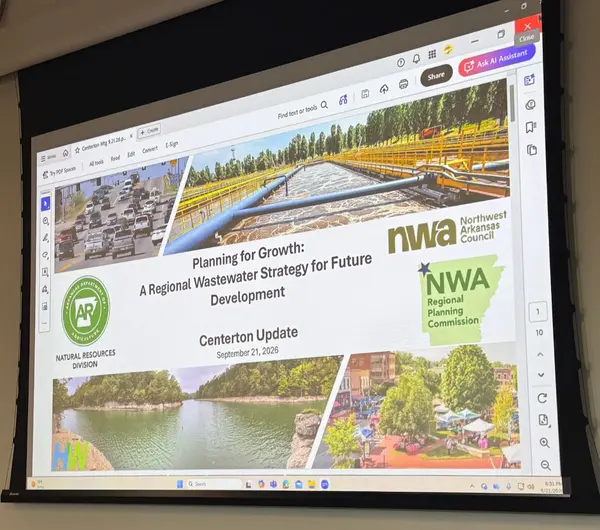
New Town Center Future Land Use and Zoning Framework
This was one of the most important discussions of the night.
Staff introduced proposed amendments to the Future Land Use Plan and Title 14 related to the future New Town Center.
A public hearing is scheduled for June 2, 2026.
Why This Is Coming Forward
Staff explained that Centerton’s current Land Use Plan does not fully account for the larger expansion of the downtown study area.
The original downtown boundary is smaller than the newer area being studied.
To protect the New Town Center area while the downtown planning work continues, staff is proposing a Future Land Use Plan amendment.
The proposed new land use categories are:
• Corridor District
• Core District
• Mixed Use District
• Neighborhood Transition
These categories are meant to help guide development in and around the future New Town Center while the larger downtown plan is being completed.
What the Categories Mean
The Corridor District was described as the connector between Old Downtown and the future New Downtown.
The Core District is where the most intense commercial activity is expected.
The Mixed Use District is intended for live, work, play style development.
The Neighborhood Transition area is intended to transition back toward surrounding neighborhoods while still supporting a denser pattern than typical single family subdivision development.
The west boundary of part of the mixed use area came up because of the shape of the map. Staff explained that the boundary follows floodplain and open space considerations.
New Town Center Planned Zoning District
Staff also introduced a proposed new zoning district called the New Town Center Planned Zoning District, or NTC PZD.
The simplest way to understand it:
It works somewhat like a PUD, but as a zoning district specifically for the New Town Center area.
A developer would need to request a rezone into this district and provide:
• A general site concept
• Proposed uses
• Open space locations
• A development approach that fits the New Town Center vision
The idea is to create a negotiated process between the developer and the city.
This gives the city more control and flexibility while the downtown plan is still being finalized.
Public Input
Staff also mentioned upcoming public input opportunities tied to the downtown planning process.
Dates discussed included activity around the farmers market, a public input meeting, stakeholder meetings, and Coffee with the Mayor.
The important point is this:
The downtown planning work is moving from theory into public conversation.
What this means for residential real estate
This is a big deal.
The New Town Center is one of the most important long term planning conversations in Centerton.
It could shape:
• Walkability
• Mixed use development
• Future housing types
• Commercial activity
• Public gathering spaces
• Traffic flow
• Trails and connectivity
• Long term buyer demand
• The identity of Centerton’s core
The biggest takeaway is that the city is trying to protect the area before piecemeal development locks in patterns that do not support the downtown vision.
That matters.
Once land develops the wrong way, it is very hard to undo.
Planning Commission Bylaws
The Commission then continued reviewing Planning Commission bylaws.
This has been discussed at multiple meetings now.
The goal is to clean up outdated language and make the process fit how Planning Commission actually operates today.
Appointment and Application Process
Staff reviewed language related to terms and appointments.
The draft keeps three year terms, but does not create term limits.
However, the discussion included a more open application process before a term expires.
The draft language discussed would have notice published and posted before expiring terms, with applications reviewed and selected candidates interviewed.
The interview group discussed included the mayor, Planning Director, and Planning Commission Chair, or designees.
The idea is to allow current commissioners to reapply, while also creating a clearer process for new applicants.
Attendance
Attendance language was also discussed.
Because Planning Commission now meets twice a month, the old absence rules do not fit as well.
The proposed structure discussed included possible action if a member misses:
• Four consecutive regular meetings
• Or six meetings within one year
There would be exceptions for extraordinary circumstances.
Commissioners also discussed how members should notify staff if they will miss a meeting, including email notification.
Quorum and Work Sessions
The bylaws discussion also covered quorum.
With nine members, a quorum would be five.
The Commission also discussed adding language for work sessions.
Work sessions would be open to the public, but no formal action would be taken and public comment would not be required.
This matters because some planning and zoning policy topics need discussion before they are ready for formal action.
Public Hearing Procedure
The bylaws draft also adds more detailed public hearing procedures.
That includes:
• The chair announcing the subject
• Rules of conduct for public comment
• A three minute time limit when needed
• Written correspondence being read or summarized into the record
• The public hearing being formally closed before deliberation
• Commission discussion and action happening after public comment
This is meant to make the process clearer and more consistent.
Voting, Abstention, and Recusal
The Commission also discussed voting procedures.
The main idea was that members should vote on matters unless they have a conflict of interest.
If there is a conflict, the member should recuse before deliberation and step away from the Commission table.
They can still speak as a member of the public if appropriate, but they should not participate in Commission discussion or action on that item.
This is the kind of detail that matters for public trust.
Outcome
No final bylaw adoption happened during this discussion.
The Commission continued working through the language.
Why this matters for residents
Process matters.
Planning Commission handles rezones, conditional uses, plats, development plans, waivers, and code changes.
Those decisions affect neighborhoods, roads, development patterns, property values, and daily life.
Clear bylaws help make sure the process is fair, consistent, and easier for residents and applicants to understand.
Schedule of Uses
The final major discussion was the Title 14 Schedule of Uses.
This is the long running code cleanup project that determines which uses are permitted, conditional, or not allowed in each zoning district.
At this meeting, the Commission continued final review of uses in agricultural, commercial, and industrial zoning districts, with staff comments on the agricultural zone.
This discussion got into some very specific uses, including:
• Taxidermy
• Alcohol manufacturing versus microbrewery and restaurant use
• Petroleum extraction
• Stockpiling
• Broadcasting studios
• Small cell towers
• Planned unit development in agricultural zoning
• Mixed use in agricultural zoning
Some of these sound oddly specific.
But that is the point.
A good zoning code needs to be specific enough that residents, developers, staff, and commissioners know how to handle unusual requests before they show up.
Examples From the Discussion
Taxidermy led to conversation about where that kind of use belongs, whether it can operate as a home occupation, and whether chemical storage could change how it should be classified.
Petroleum extraction was discussed even though it may not be a likely request in Centerton.
Stockpiling came up because the city has seen issues where dirt or material is brought in or hauled out, creating truck traffic and impacts on nearby areas.
Broadcasting was discussed because modern broadcasting may not look like the old version of a radio tower and studio.
Small cell towers were also mentioned as a use that needs to be properly addressed in the code.
The Commission also talked through whether some uses belong in A1 agricultural zoning at all, or whether they should be removed, conditional, or handled through a different zoning process.
Why Schedule of Uses Matters
This is not exciting work.
But it is important.
The Schedule of Uses determines what can happen near homes, farms, commercial corridors, and industrial areas.
It helps answer questions like:
Can this use go here by right?
Does it need a public hearing?
Does it belong somewhere else entirely?
Will it create truck traffic?
Could it affect nearby homes?
Does it need conditions?
Is it really commercial, industrial, agricultural, or something else?
For homeowners, this matters because zoning is one of the ways a city protects neighborhood compatibility.
Announcements
The next Planning Commission meeting is scheduled for June 2, 2026.
The next City Council meeting is scheduled for June 9, 2026.
The next Tech Review meeting is scheduled for May 21, 2026, by Zoom.
The meeting adjourned at 8:10 PM.
My Takeaways for Centerton Homeowners
This meeting had several residential takeaways.
1. Short term rentals are still moving through one by one
The Hein short term rental approval shows the city is continuing to review STRs individually.
Even when there is no public opposition, parking, occupancy, management, quiet hours, safety, and neighborhood rules still matter.
2. Main Street commercial transition is getting more careful
The Centerton IT Office project shows what happens when a residential structure becomes commercial.
The Commission looked at parking, drainage, access, screening, street improvements, and future connectivity.
That is exactly the kind of review needed as Main Street evolves.
3. Drainage details matter
The IT office parking lot drainage discussion was a good reminder that code compliance is not the only question.
How a site functions in real life matters too.
Parking lot ponding, runoff paths, outlet design, and downstream drainage all affect surrounding properties.
4. Bentonville West improvements support community appeal
The locker room addition and field improvements are school facility investments.
For families, school campuses are part of the residential experience.
For nearby homeowners, buffering, lighting, drainage, and access are the pieces to watch.
5. New Town Center planning is entering a critical phase
The proposed land use categories and New Town Center Planned Zoning District show that the city is trying to protect the downtown study area before development patterns get locked in.
This is one of the biggest planning conversations happening in Centerton right now.
6. Bylaws and process are not boring when they affect your neighborhood
Clear rules for hearings, voting, recusal, attendance, and applications help the Planning Commission function better.
That matters when the decisions being made affect real neighborhoods.
7. Schedule of Uses is the quiet rulebook
The Schedule of Uses will shape what is allowed in agricultural, commercial, and industrial areas.
That can affect homeowners more than people realize, especially when uses involve traffic, storage, noise, chemicals, outdoor activity, or proximity to homes.
What This Means for Residential Real Estate
This meeting was a good reminder that residential real estate is shaped by more than home prices.
It is shaped by:
• Short term rental approvals
• Main Street commercial reuse
• Parking and access decisions
• Stormwater planning
• School improvements
• Landscape buffering
• Future downtown zoning
• Public process
• Land use categories
• What the code allows near homes
These decisions eventually show up in neighborhood feel, buyer demand, property values, walkability, traffic, and quality of life.
Centerton is not just growing.
It is deciding what kind of growth it wants.
That is why I keep watching these meetings.
Because the decisions that shape the market usually happen before most people see them in a listing, a showing, or a sales price.
Let’s Talk Strategy
If you are thinking about buying or selling in Centerton, or if you want to understand how nearby development, zoning, short term rentals, drainage, or New Town Center planning could affect your home’s value or future plans, let’s talk.
I follow the details so you do not have to.
Allie Verdery, The Blue Haired Broker
Centerton Luxury Real Estate Advisor
Engel & Völkers Bentonville
314.517.3196
allie.verdery@evrealestate.com
thebluehairedbroker.com
Bookmark the blog and check back after the next meeting. I’ll keep translating Planning Commission into real world real estate context.
Categories
Recent Posts