Centerton City Council Recap: April 14, 2026
Recreation Center pricing, sewer capacity realities, new lots, rezonings, city communication, and the infrastructure questions behind growth
Some City Council meetings are mostly routine.
This one was not.
The April 14 meeting covered a lot of ground: final plats for new residential lots, several rezones, the guaranteed maximum price for the Centerton Recreation Center, a new community notification system, a detailed sewer capacity update, a revised vacation buyback policy, Building Safety Month, and a few personnel related decisions after executive session.
But the biggest theme of the night was simple.
Centerton is growing, and every decision is tied back to how the city keeps up.
Roads.
Sewer.
Parks.
Communication.
Staffing.
Building safety.
Housing supply.
Here’s what happened and why it matters for residential real estate.
Opening Business
The meeting opened with the pledge, prayer, and roll call.
Council approved the March 10 City Council minutes and acknowledged receipt of:
• Water and Sewer Commission minutes from February 18
• Planning Commission minutes from March 3 and March 17
Financial Report
The city is 25 percent through the year, and expenses were tracking very close to that at 24.88 percent.
Revenue was slightly higher, but the mayor again noted that some of that is due to carryover from the beginning of the year.
A few important notes:
• Building permits are down a little
• The mayor said sewer news later in the meeting could hopefully help that
• Sales tax and county sales tax are on schedule
• Departments are still tracking well
• Street fund revenue was at 44 percent
• Street fund expenditures were at 17 percent, with several projects still in the works
The financial and court reports were approved.
What this means for homeowners
This is one of those quiet but important items.
A city growing as fast as Centerton needs stable finances to keep up with roads, parks, staff, police, fire, utilities, and infrastructure.
When finances are tracking as expected, it gives the city more room to plan instead of constantly react.
For homeowners, that matters because city stability is part of long term property value.
Public Comment
Two residents spoke during public comment.
Growth, Metrics, and Moratorium Questions
Thomas C. Lowkes spoke first and began by complimenting the city website, saying it had improved and become more useful.
He then raised concerns about Centerton’s growth rate.
He referenced population growth numbers and asked whether the city is prepared for the work ahead if Centerton continues growing quickly. His questions focused on metrics, including:
• Whether city finances are growing at the same pace as population
• What police staffing ratios should look like
• What fire staffing ratios should look like
• Whether the city would consider a building permit moratorium if growth outpaces infrastructure
That last question was intentionally direct.
One council member responded that they are for growth and would rather put in the work than pursue a moratorium.
Why this matters for real estate
This is the conversation under almost every other conversation.
Growth is good for demand.
Growth can support property values.
Growth brings amenities.
Growth also requires infrastructure.
The real question is whether the city can keep roads, sewer, public safety, and services moving fast enough to support the homes being built.
Safety, Parks, and Revenue
Chris Mooney also spoke. He shared that someone who had recently moved to Centerton commented on how safe he feels here with his family.
Chris also noted the city’s parks and grant success, congratulating the city on what he described as a strong run of parks and grant funding.
Why this matters for homeowners
Safety and parks are two of the biggest quality of life factors buyers notice.
They do not always show up directly in a listing description, but they absolutely shape how people feel about a community.
Ordinances
Council voted to read ordinances and resolutions by title only and suspend the rule requiring ordinances to be read on three separate occasions.
Ordinance 2026-06
Solid Waste Collection Services
This was the Waste Management contract.
Again, it was not ready.
The mayor explained that the city attorney and Waste Management are still working through legal language. They are close, but not finished.
The current agreement was extended through May 31 so trash service continues while the contract is finalized.
Council voted to table the ordinance.
What this means for homeowners
Trash service continues.
The city is taking more time before locking in a five year contract, which is a good thing when the contract affects every household in Centerton.
Ordinance 2026-07
Huber Place Phase 2 Final Plat
Council approved the final plat for Huber Place Phase 2, located around Tycoon and Huber Roads.
This creates residential lots 114 through 162 and Tract G.
The mayor described this as 49 lots, with Tract G appearing to be the drainage lot.
Bonds listed included:
• Curb and gutter bond: $79,178
• Water and sewer bond: $289,308
• Streets and drainage bond: $295,468.11
The Planning Commission had already recommended approval.
Outcome
Approved unanimously.
What this means for residential real estate
This is 49 more residential lots moving forward.
Final plat approval is a big step in the process. It does not mean homes appear immediately, but it does mean the subdivision is moving from planning toward buildable lots.
For buyers, that can eventually mean more new construction options.
For nearby homeowners, it means more neighbors and more activity in that area.
Ordinance 2026-08
Magnolia Landing Phase 3 Final Plat
Council approved the final plat for Magnolia Landing Phase 3 on Vaughn Road.
The ordinance accepts lots 115 through 192, Tracts G and H, and a replat of Tracts D, E, and F in Magnolia Landing Phase 2.
The mayor described it as additional lots in an area where homes already exist.
Bonds listed included:
• Water and sewer bond: $509,124.25
• Street and drainage bond: $757,535.55
• Performance bond: $101,371.48
The city attorney added language clarifying that approval of the final plat does not equal acceptance of public improvements. Public improvements still require inspection and separate acceptance by the city, and the developer and surety remain responsible for completion, maintenance, and correction of defects under the city code and applicable bonds.
Councilmember Josie Reed abstained because of a relationship with Schuber Mitchell and stated she did not want it to appear that she was favoring them.
Outcome
Approved, with one abstention.
What this means for residential real estate
This is another major batch of single family lots moving forward.
Magnolia Landing continues to be part of Centerton’s new construction pipeline.
The added legal language also matters because it protects the city and future residents. A final plat can move forward, but the infrastructure still has to meet standards before the city formally accepts it.
That is not just paperwork.
It affects roads, drainage, utilities, long term maintenance, and the quality of the neighborhood homeowners eventually inherit.
Ordinance 2026-09
Twelve Stone Construction Rezone
Bliss and Keller Roads
C3 Neighborhood Commercial to R3 Single Family
Council approved rezoning the Twelve Stone Construction property at Bliss and Keller from Neighborhood Commercial to Medium High Density Single Family Residential.
The mayor explained this property had gone through Planning Commission and was recommended unanimously.
There were no public comments during the Planning Commission hearing.
This rezone matches the residential character of the surrounding area.
Outcome
Approved unanimously.
What this means for nearby homeowners
This is a residential leaning decision.
Instead of keeping a commercial zoning designation that did not lay out well due to access and driveway spacing concerns, this property is moving back toward single family residential use.
For nearby homeowners, that likely means fewer commercial impacts at that location and a cleaner transition into surrounding neighborhoods.
Ordinance 2026-10
Jesse W. King Living Trust Rezone
LC Hickman Road
A1 Agriculture to RE Residential Estate
Council approved rezoning the Jesse W. King Living Trust property from Agriculture to Residential Estate.
The mayor explained that a tract split created a parcel under 10 acres. Since A1 Agriculture requires at least 10 acres, the property became nonconforming and needed a different zoning category.
There was one public comment during Planning Commission, but it was a resident asking questions rather than opposing the rezone.
Council asked about how this aligns with the future land use plan, especially because the area shows higher density and some commercial planning nearby.
Staff explained that the rezone preserves the existing residential estate use and brings the property into compliance with its size and current use. It is not a development request.
Outcome
Approved unanimously.
What this means for residential real estate
This is an important distinction.
A rezone does not always mean new development is coming.
In this case, it appears to be more about making an existing home and acreage legally fit the right zoning after a tract split.
For nearby residents, this does not approve dense development. It preserves the estate residential use on that specific parcel.
Ordinance 2026-11
RMC 102 West Centerton Rezone
A1 Agriculture to C2 Highway Commercial
Council approved rezoning RMC 102 West Centerton LLC property from Agriculture to Highway Commercial.
This property is along West Centerton Boulevard.
The Planning Commission had already heard the item, received no public comments, and recommended approval.
Outcome
Approved unanimously.
What this means for residential real estate
This is another step in the commercial evolution of Centerton Boulevard.
For homeowners, commercial growth along major corridors can be both helpful and important to watch.
It can bring:
• More services
• More convenience
• More sales tax opportunity
• More activity along major roads
But it also makes access management, traffic planning, and buffering more important as commercial development gets closer to residential areas.
Ordinance 2026-12
DR Horton Drainage Easement
West Wind Subdivision
Council approved accepting a three foot drainage easement dedication from DR Horton for Lot 1R in West Wind Subdivision Phase 1.
Outcome
Approved unanimously.
What this means for homeowners
Drainage easements are not flashy, but they matter.
They help manage stormwater, clarify responsibility, and protect neighboring properties.
In a fast growing city, small drainage details can become big homeowner issues if they are not handled correctly.
Resolutions
Resolution 2026-14
Guaranteed Maximum Price for the Centerton Recreation Center
This was one of the biggest items of the night.
Council approved the guaranteed maximum price agreement with Crossland Construction for the new Centerton Recreation Center.
The project team included WBR and Crossland Construction.
The proposed facility is 35,615 square feet.
The design includes:
• Community room
• Gymnasium
• Indoor aquatics area
• Administration and reception area
• Restrooms
• Workout space
• Indoor walking track
• Outdoor covered entry and patio style space
They also discussed future expansion areas, including space for future tennis, pickleball, outdoor aquatics, and a future indoor competition pool.
The team emphasized that the design was intentionally laid out so the building can grow as Centerton grows.
Guaranteed Maximum Price
The guaranteed maximum price discussed was approximately $20.6 million.
Council asked whether the project could still see change orders.
The answer was that the guaranteed maximum price covers the drawings and scope as presented. Change orders would generally come from things the city adds.
The team also said they tried to manage risk through allowances for things like rock, sewer lines, and other potential site issues.
If those allowances are not needed, the money can come back to the city.
Timing and Sewer Approval
Council asked what happens if the project is delayed past July 1, especially given utility approval uncertainty.
The project team explained that if approval comes quickly, they would like to start around May 1. If approval is delayed too long, some pricing may need to be reevaluated because contractors cannot hold pricing indefinitely.
The mayor also mentioned that, as a worst case sewer scenario, the city had discussed a storage tank and pump out option, but that would be far down the road and not the preferred path.
Operating Costs
Council also asked about future operating costs.
This is important.
The facility will not just cost money to build. It will also cost money to run.
The mayor said a consultant had already studied staffing, salary needs, membership fees, and operational assumptions. Those operating costs are not part of the construction price, but the study was part of the planning work and will need to be revisited during future budgeting.
Bidding
The team said the project came in under budget when sent out to bid by about 4 percent. Instead of spending time trying to cut things out, they were able to look at opportunities to add items back in.
They also mentioned receiving around 130 bids and said the timing seemed favorable.
Councilmember Josie Reed abstained because of a business relationship with both WBR and Crossland.
Outcome
Approved, with one abstention.
What this means for residential real estate
This is a major quality of life investment.
Recreation centers matter because they create year round amenities for families, seniors, youth sports, fitness, and community gathering.
For homeowners, amenities like this can strengthen community appeal.
For buyers, especially relocating families, recreation infrastructure helps a city feel more complete.
This is one of those projects that can change how people talk about living in Centerton.
Resolution 2026-15
GoGov Community Notification System
Council approved an agreement with GoGov for a community notification system.
The mayor explained that this is a phone app and communication tool that can push out city information more directly to residents.
Examples discussed included:
• City Council agendas
• Road closures
• Weather updates
• Trash service information
• Ward maps
• Water bill links
• Code enforcement reporting
• Tall grass or trash concerns
• Events and city updates
The mayor said Pea Ridge and Little Flock use similar tools and spoke positively about them.
The cost is $14,280 per year with no setup fee and free training.
Council asked whether it could be absorbed in the current budget. The answer was yes.
The system is expected to take roughly 30 to 45 days or possibly 6 to 8 weeks to get set up.
Outcome
Approved unanimously.
What this means for residents
This is a practical win.
Right now, city information is spread across multiple places: website, Facebook, Instagram, X, Public Works pages, Police, Fire, and other channels.
A notification system gives residents a more direct way to receive updates instead of hoping the algorithm shows them a road closure or city announcement.
For homeowners, that means better access to the information that affects daily life.
Sewer Capacity Update
Aaron Benzing
This was the most technical and probably most important discussion of the night.
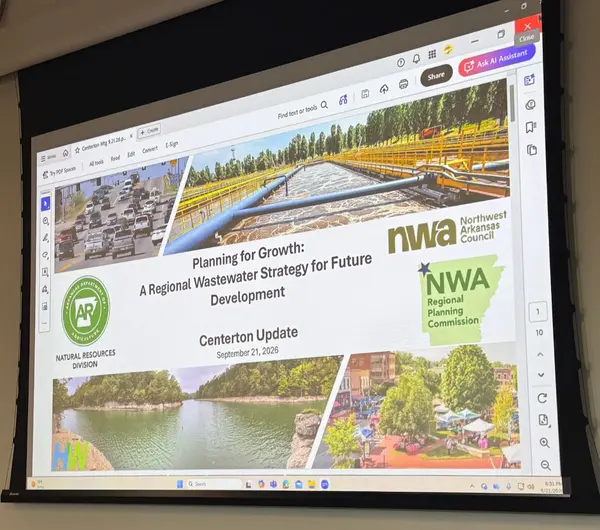
Aaron Benzing gave an update on the regional wastewater study.
The city had hoped to have a final report by April, but two major financial pieces are still missing:
• Decatur’s updated rate information
• NACA connection cost and rate information
Decatur is working on a rate study expected around June or July.
The NACA numbers are also still being worked through.
Because of that, the final recommendation with financial comparisons is expected later, likely around September.
The Three Main Options Discussed
Aaron outlined three main options.
Option 1: Stay Fully with Decatur
This is closest to the status quo.
Centerton has been sending flow to Decatur, and Decatur has been a regional partner.
The issue is timing.
Aaron explained that if Centerton committed entirely to Decatur and relied on Decatur to expand enough to keep up with Centerton’s full growth, it could take about 10 years to get the treatment capacity needed.
That would likely mean continued growth delays.
Option 2: Build Centerton’s Own Treatment Facility
This option gives Centerton more control, but it has major obstacles.
Aaron said Centerton could pursue its own treatment facility, but:
• It would likely take at least 7 years to site, permit, build, and bring online
• Permit limits would be very strict due to Arkansas and Oklahoma water quality agreements
• The facility would be expensive
• Centerton also has financial and service area obligations tied to Decatur
• The state may not allow Centerton to simply pull all flow away from Decatur
Because of cost, timing, and regional obligations, Aaron did not describe this as a strong option right now.
Option 3: Build a Pipeline to NACA
The third option is building a pipeline to the Northwest Arkansas Conservation Authority treatment facility.
This does not mean sending all of Centerton’s flow to NACA.
The idea is to keep sending as much flow as possible to Decatur if Decatur remains the lower cost option, while also creating a second path for overflow or future growth so Centerton is not stuck when Decatur’s facility is full.
This is the option the sewer commission is beginning to explore through planning, route study, easement work, and early negotiation.
Aaron emphasized that this does not commit the city to building the pipeline yet. It starts the planning work because that work takes time.
He said if the city waits until September to begin route planning, and the pipeline takes two to two and a half years to build, Centerton could find itself in another deficit situation.
The Hard Truth
Aaron was very clear about two things:
• None of the options fully avoid growth disruption in the short term
• Sewer costs to the utility are going to go up under any scenario
He also said there are solutions that could eventually put Centerton in a position where sewer infrastructure is no longer what holds the city back.
That is the goal.
NACA Capacity
Aaron clarified that the NACA facility appears to have immediate capacity for Centerton’s needs and the ability to grow over time.
The projections shown were not meant to predict exactly when NACA will expand. They were meant to show that NACA has a clearer ability to scale as needed.
Existing Project List and Near Term Capacity
Council asked about the current list of projects waiting on sewer approval.
The discussion got into several layers.
Decatur Expansion
Decatur is expanding from 3.8 million gallons per day to 5.36 million gallons per day.
Aaron said that once Decatur’s work is complete, hopefully this summer, there should be enough capacity to satisfy the existing waiting list for Centerton and Decatur.
However, that does not mean a new waiting list will not begin building while the long term solution is still being planned.
Legal Challenge
There had been a challenge related to Decatur’s permit.
Aaron explained that the challenge had been thrown out due to legal issues, though the challenging group still had time to appeal.
Even if the challenge moves forward, the understanding shared was that Decatur would likely still be allowed to treat the additional wastewater during the process because the challengers had likely lost the ability to get a stay issued.
Internal Pinch Points
There are also internal Centerton collection system constraints.
Two sewer improvement projects have been approved by ADEQ. These are designed to address strategic pinch points in the city’s collection system.
TJ explained that those two sewer interceptors are in key places and that Centerton also needs to think about how future flow could be moved toward NACA, especially since much of Centerton’s current sewer flow is north of Highway 102.
The cost estimate for these internal improvements was discussed in the range of roughly $8 million, with the possibility that broader infrastructure planning could reach closer to $15 million.
Flow Calculations
The study is using more realistic flow numbers than the commonly referenced 100 gallons per day figure.
Aaron said the report uses 65 gallons per day, which better reflects historical data.
There was also discussion that regulatory agencies are reviewing how applications are calculated, and Centerton is in month nine of twelve months of flow monitoring.
A lot of the next information is expected to converge around June and July.
Motion of Support
Council was asked to support the Sewer Commission in pursuing the NACA option and beginning negotiations.
Council approved that motion.
What this means for residential real estate
This is the most important market issue in Centerton right now.
Sewer capacity affects:
• Which subdivisions can move forward
• How quickly new lots become available
• Whether approved projects can get final plat
• Builder timelines
• New construction inventory
• Rental supply
• Pricing pressure
• Commercial development
• Future growth patterns
The good news is that the city is no longer just talking about the problem.
It is actively narrowing options and beginning planning for a long term solution.
The hard part is that none of this is instant.
Vacation Buyback Policy
Council approved a revision to the vacation buyback policy.
The change sets the normal request window from May 1 through October 1.
The mayor explained that early year funds can be tighter in January, February, and March. By May through October, the city usually has better turnback revenue and is in a stronger financial position.
There is still a hardship exception. If an employee has a need outside that window, the city can consider it case by case.
Outcome
Approved unanimously.
Building Safety Month
Mayor Edwards proclaimed May 2026 as Building Safety Month in Centerton.
The proclamation recognized the importance of:
• Building codes
• Fire prevention
• Safe construction
• Architects, engineers, builders, tradespeople, and laborers
• Disaster preparedness
• Resilient communities
The city plans to share building safety tips throughout May.
What this means for homeowners
Building safety is directly tied to property value.
Strong codes and inspections help protect residents, buyers, and long term housing quality.
This especially matters in a fast growing city where construction activity is high and buyers need confidence in the homes being built.
Other Business
There was no additional open session other business before executive session.
Executive Session
Council went into executive session to discuss personnel matters, including hiring and a promotion in the Public Works Department.
After returning to open session, two items were approved.
Returning Splash Pad Attendant
Council approved bringing back a returning splash pad attendant at $16 per hour, which is one dollar more than the prior rate discussed.
Outcome
Approved unanimously.
Assistant Public Works Director Salary Adjustment
Council approved adjusting the Assistant Public Works Director salary to $96,262.40.
The mayor explained the goal was to bring the assistant director position in line with the second in command positions in the police and fire departments.
Outcome
Approved unanimously.
What this means for residents
Public Works touches daily life more than people realize.
Roads, drainage, parks, storm response, maintenance, and city infrastructure all depend on having strong people in those roles.
Retention and fair compensation matter when a city is growing this quickly.
Announcements
Coffee with the Mayor was announced for Saturday, April 18 at 9 AM at the Community Building, 290 North Main Street.
The citywide garage sale was also mentioned at the end of the meeting.
My Takeaways for Centerton Homeowners
This meeting had several major themes.
1. The Recreation Center is moving from concept toward reality
Approving the guaranteed maximum price is a big milestone.
The design includes core amenities residents have been asking for, with room for future expansion as the city grows.
For homeowners, this is a quality of life investment that can help Centerton feel more complete.
2. Sewer capacity is still the biggest growth issue
Even with encouraging signs, sewer is still complicated.
Decatur may help clear the current list.
Internal pinch points still need work.
NACA planning is moving forward.
Final financial comparisons are still coming.
This will continue to affect housing supply and timing.
3. New residential lots are still moving forward
Huber Place Phase 2 and Magnolia Landing Phase 3 both moved ahead.
That is important for new construction inventory, especially while other projects remain tied to sewer capacity.
4. Rezones are shaping the edges of residential growth
The Twelve Stone rezone moved land back toward single family use.
The King Trust rezone preserved an estate residential use.
The RMC 102 rezone continued the commercial evolution of Centerton Boulevard.
These decisions shape what homes are near and how neighborhoods connect to services.
5. Communication is getting an upgrade
The GoGov system should make it easier for residents to get updates without relying only on social media.
That matters for road closures, city events, weather, code enforcement, trash, and general awareness.
6. Growth is not just about approvals
Growth also requires people.
Public Works.
Building Safety.
Planning.
Utilities.
Police.
Fire.
The personnel and policy items may seem small, but they are part of how the city keeps functioning while everything around it grows.
What This Means for Residential Real Estate
This meeting was a perfect example of why I follow City Council so closely.
Residential real estate is not just about bedrooms, bathrooms, and square footage.
It is also about:
• Sewer capacity
• Road access
• Recreation amenities
• Drainage
• Public safety
• City communication
• New construction inventory
• Commercial convenience
• Long term infrastructure planning
Every one of those pieces affects buyer demand, neighborhood livability, and property value over time.
Centerton is still growing.
The question is how thoughtfully we manage that growth.
Let’s Talk Strategy
If you are thinking about buying or selling in Centerton, or if you want to understand how nearby development, infrastructure, or city decisions could affect your home’s value, your neighborhood, or your future plans, let’s talk.
I follow the details so you do not have to.
Allie Verdery, The Blue Haired Broker
Centerton Luxury Real Estate Advisor
Engel & Völkers Bentonville
314.517.3196
allie.verdery@evrealestate.com
thebluehairedbroker.com
Bookmark the blog and check back after the next meeting. I’ll keep translating City Council into real world real estate context.
Categories
Recent Posts