Centerton Planning Commission Recap: March 3, 2026
Coffee on Main Street, future access planning, food truck relocation, and another deep dive into Centerton’s zoning code
Some Planning Commission meetings are about one big development.
This one was more about the details behind the details.
Access points. Shared drives. Future connectivity. Whether a coffee shop should connect to city owned property. Whether food trucks need a new application when they move lots. What belongs in commercial zoning versus industrial zoning. And, of course, sewer capacity quietly sitting in the background of almost everything.
If that sounds overly technical, stay with me.
These are the kinds of decisions that affect how easy it is to get around town, what gets built near neighborhoods, whether Main Street develops in a connected way, and how future residential property values are protected.
Here’s what happened.
Approval of Minutes
The Planning Commission approved the February 17, 2026 meeting minutes.
No opposition.
Administrative Approvals
Two home occupation approvals were ratified.
The Angry Veterans Mobile Service and Repair
740 Napa Avenue
Mobile mechanic
Zoned R2 in Sonoma Valley
Natural State Connections
531 Cass Road
Online referral and marketing service
Zoned R3 single family in Centerpoint
Both were approved as administrative items.
What this means for residential real estate
Home based businesses continue to be a normal part of how people live and work in Centerton.
The key with these approvals is impact.
When a home occupation stays low impact and does not change the feel of a neighborhood through traffic, signage, noise, or parking concerns, it can usually fit within residential areas.
For buyers, this is also a reminder that flexible home office space matters. Whether someone is running an online business, working remotely, or managing a side business, floor plans with extra office space continue to be valuable.
Old Business
Ameera’s Kitchen Food Truck: Withdrawn
This was the food truck proposal from the February 17 meeting that was originally planned behind the existing car wash at 100 Blake Drive.
At the last meeting, Planning Commission raised concerns about:
• Proximity to homes
• Parking
• Restroom access
• Trash service
• Buffering
• Site circulation
• Whether the food truck could function independently on that lot
For March 3, the item was withdrawn.
The applicant is now looking at submitting a new conditional use application to place the food truck on the car lot property west of the car wash instead. Because that is a separate property, it requires a new application.
What this means for nearby homeowners
This is exactly how the process is supposed to work.
The Commission raised concerns.
The applicant listened.
The original request was pulled.
A revised request may come back on a different site.
That does not mean the food truck is approved or denied yet. It means the specific request from February 17 is no longer moving forward in that form.
For residents near Blake Drive, this matters because the next application should be reviewed based on the new property, new layout, new parking plan, and new proximity to nearby homes.
New Business
Coffee House on Main Street
567 North Main Street
Waiver Request from Title 15 Access Management and Connectivity Requirements
This was the main development item of the night.
The proposal is for a coffee shop on North Main Street. The project would remodel an existing 2,932 square foot home and add an 840 square foot covered patio. The existing structure would become a coffee shop with indoor and outdoor seating.
The applicant also has a large scale development application pending, but that application depends on the outcome of this waiver request.
Where is it?
The property sits at 567 North Main Street.
Nearby context matters here:
• To the north is city owned property shown as future Veteran’s Park
• To the south and west are undeveloped properties
• To the east, across Main Street, is Sienna at Cooper’s Farm
• The property is zoned C1, which is Centerton’s central business district
The staff report described C1 as the retail core of the city. That is important because Main Street is expected to function differently than a typical neighborhood road.
This is not just about one coffee shop.
It is about how Old Downtown and Main Street continue to develop over time.
The Waiver Request
The applicant asked for a waiver from Centerton’s access management and connectivity requirements.
In plain English, the city’s code requires developing properties to plan for future connections to adjacent undeveloped parcels. The reason is simple: when properties connect internally, not every business has to send traffic directly onto Main Street.
That means fewer driveways.
Fewer turning movements.
Better traffic flow.
Safer access over time.
The coffee shop already worked out a shared access easement with the property to the south. Their plan was to build asphalt on their portion of that access drive, while the section on the neighboring southern property would remain gravel until that property develops.
The part they did not want to provide was connectivity to the north.
Their reasoning was that the property to the north is city owned and shown as future Veteran’s Park, so they felt a driveway connection to that property was unnecessary and could become a permanent dead end.
Staff’s Concern
Staff acknowledged that the property to the north is shown as Veteran’s Park, but pointed out that no development plans have been submitted for that property yet.
That distinction mattered.
Just because a property is planned as a park does not mean the access question disappears. It is still city owned property. It will still need access. And whatever eventually happens there, staff wanted the area planned in a way that avoids too many future driveways onto Main Street.
Staff’s position was that cross access through the coffee shop property could reduce turning movements and improve overall downtown traffic flow and safety.
Commission Discussion
This was the part that really mattered.
Commissioners talked through whether access could realistically be provided to the north.
There was discussion around:
• Whether a stub connection should go toward the future park property
• Whether the drive could run along the west property line
• Whether access could eventually loop back toward Main Street
• Whether Sandy Lane being private created complications
• Whether future development north and west of the site would need better access options
• Whether the site could preserve connectivity without sacrificing too much parking
One commissioner noted that if the drive went north from the parking area, it would need to function as two way traffic, which would likely require a 24 foot wide drive.
There was also discussion that the current plan showed 21 parking spaces where 20 were required. If the drive connection caused them to lose two spaces, they would be short. But commissioners also talked through possible alternatives, including adding head in parking near the dumpster area.
The larger point was this:
They did not see the parking issue as impossible to solve.
And if the choice was between preserving future connectivity or losing one parking space, the Commission seemed to prioritize future connectivity.
One commissioner said they would rather have the cross access and one less required parking stall than lose the connection altogether.
The Waiver Standard
For a waiver to be granted, Planning Commission had to find all four required findings.
The most important one in this discussion was whether there were special circumstances that made strict application of the rule unreasonable for the applicant.
Commissioners did not see that.
The comment that summed it up was that they did not see a hardship other than design.
In other words, the site plan may need adjustment, but that alone did not rise to the level needed to waive the city’s connectivity requirement.
They also discussed public health, safety, access, and long term development.
Outcome
The waiver request was denied unanimously.
Each commissioner voted no.
The main reason: no hardship.
Several also pointed specifically to access, public safety, and future connectivity.
What this means for real estate
This decision says a lot about how Centerton is approaching Main Street.
The Commission is trying to avoid the same access problems we already see on heavily traveled corridors where every business has its own driveway and traffic has to constantly turn in and out.
For homeowners, especially those near Main Street, this matters.
Better access planning can mean:
• Safer traffic flow
• Less congestion over time
• Better long term commercial design
• More thoughtful downtown development
• Stronger neighborhood compatibility
A coffee shop on Main Street could still be a great addition. This vote was not a rejection of the coffee shop itself. It was a rejection of waiving the connectivity requirement.
The project can still come back with a revised design.
Other Business
Schedule of Uses: Commercial and Industrial Zoning
This is the kind of agenda item that sounds boring until you realize it affects almost everything about future development.
The Schedule of Uses determines what types of businesses or property uses are:
• Permitted by right
• Allowed only with conditional use approval
• Not allowed in certain zoning districts
The Commission continued reviewing commercial and industrial categories line by line.
This is long, tedious work, but it matters.
The goal is to clean up outdated categories, clarify confusing definitions, and make sure the code reflects the way businesses actually operate today.
Industrial Use Discussions
The Commission revisited some earlier categories to look specifically at how they fit within industrial zoning.
Some of the discussion included:
Animal kennels and veterinary clinics
Staff recommended allowing animal kennel, boarding, and training uses in heavy industrial. They also discussed animal clinics and small animal veterinary uses in light industrial.
The idea was to make sure these uses have a place to go, while still considering impact.
Community gardens
Staff recommended removing community gardens from industrial zones.
That makes sense. Community gardens are neighborhood and community oriented uses, not really an industrial land use.
Commercial stables
There was a longer discussion about whether riding and boarding stables belong in industrial zoning.
The Commission pushed back on that idea.
The concern was land use fit. Stables need acreage, animals per acre considerations, and a more agricultural setting. The group seemed to agree that stables make more sense in agricultural zoning rather than industrial.
Arenas and convention centers
There was discussion about whether arena, auditorium, or convention center type uses could fit in light industrial.
The challenge is that Centerton does not currently have a true business park zoning category. That means some larger uses may not fit cleanly into commercial or industrial boxes.
The Commission seemed more comfortable leaving this type of use conditional rather than permitted automatically.
Services and Retail Cleanup
The Commission then moved into services and retail categories.
This part included a lot of clarification work.
Barber shops, beauty shops, and nail salons
There was discussion about whether these should remain as separate categories or fall under a broader retail or service category.
The Commission seemed cautious about removing too many specific categories if it made the schedule harder to understand later.
Catering and commercial kitchens
Catering came up in connection with commercial kitchen uses, especially because of food trucks and prep kitchens.
The discussion centered around whether catering should remain its own category and whether industrial zoning should allow commercial kitchen type uses conditionally.
This matters because food based businesses often need off site prep space, especially if more food trucks or small food businesses come into the market.
Contractors and restoration services
Cleaning and janitorial services were discussed, including where restoration companies might fit.
The Commission talked through whether these businesses are really offices, warehouses, contractor uses, or industrial support uses.
This is a good example of why the code review matters. A modern restoration company may have office staff, trucks, equipment storage, and service crews. One simple label may not be enough.
Child care
Child care uses were also discussed, including whether the naming should be updated to reflect licensed child care centers and registered family homes.
For residential real estate, this matters because child care is one of those uses that directly affects families, neighborhoods, traffic, and daily convenience.
Short term rentals, bed and breakfasts, inns, and hotels
This was one of the more interesting residential crossover discussions.
The Commission discussed whether short term rentals should be allowed in commercial zones, especially if they are part of a mixed use development.
For example, if downtown eventually has buildings with commercial space on the ground floor and residential units above, should those upper units be able to operate as short term rentals?
The group discussed making that possible through conditional use, especially when tied to mixed use.
They also discussed simplifying the distinction between bed and breakfast, inn, and hotel uses. There was a lot of discussion about whether owner occupied versus not owner occupied really mattered, and whether 16 guests was a reasonable dividing line before something becomes more like a hotel.
This is exactly the kind of zoning detail that can shape whether downtown housing becomes flexible, walkable, and financially viable.
Offices
The Commission discussed splitting office uses by size.
Smaller offices could fit more easily across commercial zones. Larger offices may need more scrutiny, especially in neighborhood commercial areas.
That matters because small professional offices can blend well near neighborhoods, while larger office buildings can create bigger parking and traffic impacts.
Grocery stores
This may have been one of the most practical discussions of the night.
The Commission talked about whether grocery stores should be split by size so smaller neighborhood grocery concepts can fit in C3 neighborhood commercial areas, while larger grocery stores are treated differently.
There was debate over what size threshold makes sense.
The idea is important.
A small grocery or neighborhood market can be a great amenity near homes. A large grocery store has very different traffic, parking, lighting, and delivery impacts.
This is exactly the kind of distinction that matters for residential livability.
Pharmacies and marijuana dispensaries
The Commission discussed how pharmacies and marijuana dispensaries are treated under zoning.
There was concern that listing them together can alarm residents when the actual request is only for a pharmacy. But there was also discussion that state law may require them to be treated similarly.
The Commission talked through whether pharmacy type uses make sense in highway commercial and possibly neighborhood commercial, while recognizing that conditional use may be appropriate in some areas.
Restaurants
Restaurants were discussed by scale.
Smaller restaurants may make sense in neighborhood commercial areas. Larger restaurants may need more review.
The Commission also debated whether restaurants should be allowed in industrial areas, especially if they serve an industrial park or employment area.
Again, the theme was fit.
A small restaurant near homes can be a neighborhood benefit. A larger restaurant can create traffic, noise, parking, and late night activity.
Mini storage and vehicle storage
Mini storage came up again, especially the difference between traditional outdoor storage units and nicer indoor or climate controlled storage concepts.
Commissioners expressed concern about using prime commercial corridors for mini storage because it does not generate the same type of daily activity or sales tax benefit as retail.
That is a very real land use issue for growing cities.
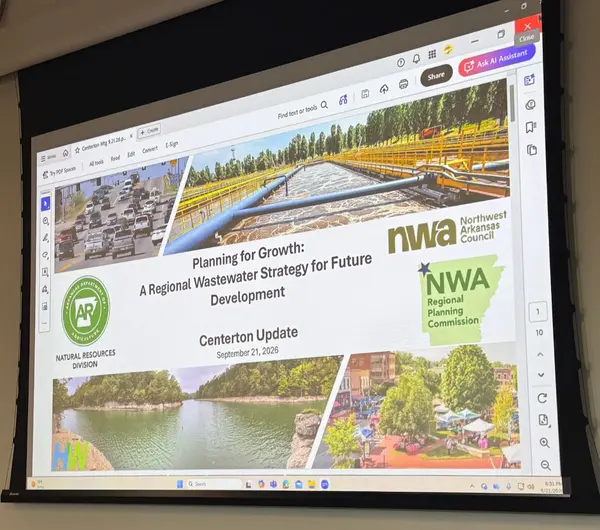
Sewer Capacity Update
Under announcements, there was also a sewer capacity update.
ADH has given the city a list of projects and Decatur has reserved capacity for 1,000 lots, equal to 0.25 million gallons per day.
There is still a 30 day appeal period, and staff made it clear they do not yet know exactly when projects will be released or how many will be able to move forward.
There was also discussion that some improvements at Decatur are still pending, including membrane and UV related work.
The key takeaway was this:
Some projects may be released, but not everything waiting will automatically get to move forward.
That is a big deal.
What this means for residential real estate
Sewer capacity continues to be one of the biggest behind the scenes factors in Centerton housing.
It affects:
• Which subdivisions can move forward
• How quickly lots become available
• New construction inventory
• Builder timelines
• Long term supply
• Future affordability pressure
When people ask why certain projects are delayed, this is often the answer.
Announcements
The next City Council meeting is March 10, 2026.
The next Planning Commission meeting is March 17, 2026.
The next Tech Review meeting is March 19, 2026.
Staff also noted that the March 17 Planning Commission meeting is expected to include a subdivision final, with a City Council meeting after it.
My Takeaways for Centerton Homeowners
This meeting had a few big themes.
1. Connectivity matters
The Coffee House waiver denial shows that the Commission is thinking beyond one project at a time.
They are looking at what happens when Main Street fills in.
That kind of long term access planning may not feel exciting today, but it can make a major difference in future traffic flow and neighborhood livability.
2. Commercial development near homes is being reviewed carefully
The Ameera’s Kitchen withdrawal shows that public concerns and Commission feedback can lead to a revised plan.
That is not anti business.
That is thoughtful planning.
3. Zoning cleanup is going to shape future neighborhoods
The Schedule of Uses discussion may sound like inside baseball, but it determines what can be built near homes.
Small grocery stores. Restaurants. Offices. Child care. Pharmacies. Short term rentals. Storage. Event uses. These all impact daily life and property value.
4. Sewer capacity is still the quiet driver
Even when it is not the main agenda item, sewer capacity remains one of the biggest factors shaping Centerton’s growth.
For buyers, sellers, and homeowners, that matters because inventory and future development timelines affect the market.
What This Means for Residential Real Estate
If you own a home in Centerton, these meetings matter.
Not because every agenda item is right next door to you.
But because the pattern of decisions shapes:
• How neighborhoods connect
• Where commercial activity grows
• Whether traffic gets better or worse
• How future amenities are placed
• What buyers value in certain areas
• How new construction supply enters the market
This is why I keep watching these meetings and breaking them down.
Because real estate is not just what is listed today.
It is what is being planned, delayed, denied, revised, and approved before most people are paying attention.
Let’s Talk Strategy
If you are thinking about buying or selling in Centerton, or if you want to understand how nearby development could affect your home’s value or neighborhood, let’s talk.
I follow the details so you do not have to.
Allie Verdery, The Blue Haired Broker
Centerton Luxury Real Estate Advisor
Engel & Völkers Bentonville
314.517.3196
allie.verdery@evrealestate.com
thebluehairedbroker.com
Bookmark the blog and check back after the March 17 meeting. I’ll keep translating Planning Commission into real world real estate context.
Categories
Recent Posts