Centerton Sewer Study Update: Four Options, a NACA Backup Plan and What Comes Next
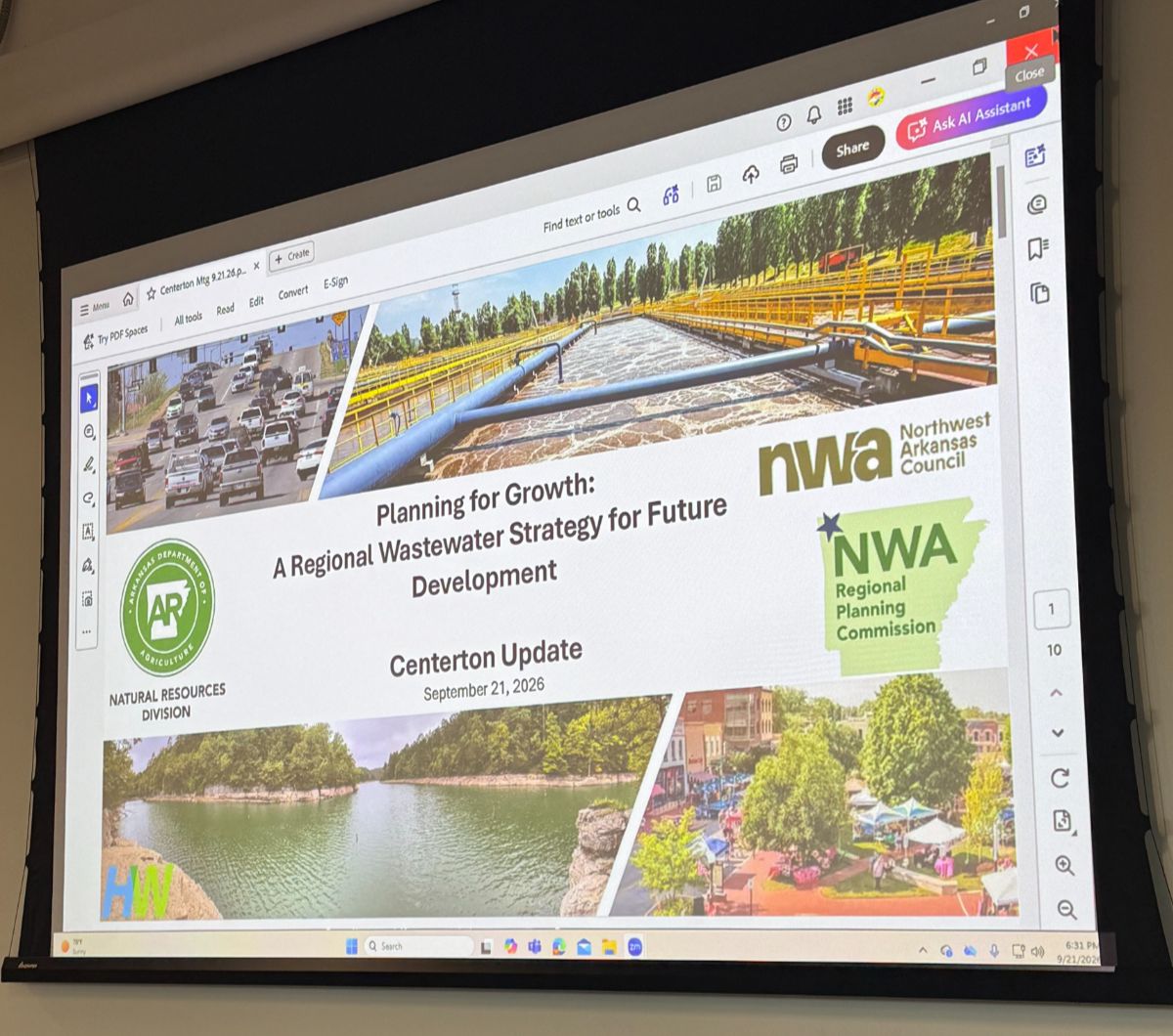
Centerton City Council and the Centerton Waterworks and Sewer Commission met jointly on September 21 for a work session focused almost entirely on one issue: what Centerton’s long-term wastewater strategy should look like as the city continues to grow.
This was not a voting meeting, so no final sewer strategy was adopted. Instead, Hawkins-Weir Engineers presented the Centerton portion of the broader Northwest Arkansas regional wastewater study, walked through four possible paths forward, compared their costs and risks, and explained where they believe Centerton should go from here.
The clearest takeaway from the presentation is that the least expensive long-term option is still tied to Decatur, but Centerton is not being advised to simply trust that one path will work out. The recommendation was to keep designing a connection to the Northwest Arkansas Conservation Authority, or NACA, while the larger questions around Decatur, Tulsa and a possible regional authority are worked through.
Why Centerton is back at this decision point
Centerton does not operate its own wastewater treatment plant. For years, the city has sent wastewater to Decatur, and that arrangement worked well until Centerton’s growth began pushing up against the limits of available capacity.
During the presentation, Hawkins-Weir engineer Aaron Benzing walked through some of that history. Centerton had previously explored building its own treatment facility, but permitting proved difficult. The city later considered NACA, then ultimately entered into the long-term arrangement with Decatur. That partnership served Centerton well for more than a decade, but the combination of rapid residential growth, treatment capacity and state permitting requirements eventually led to the development restrictions residents and builders have been hearing about over the last couple of years.
Decatur is currently expanding its treatment plant to approximately 5.36 million gallons per day, which should provide near-term relief. The concern is what happens after that. Based on the growth projections used in the regional study, Centerton could begin running into another capacity problem around 2030 if additional treatment capacity is not available by then.
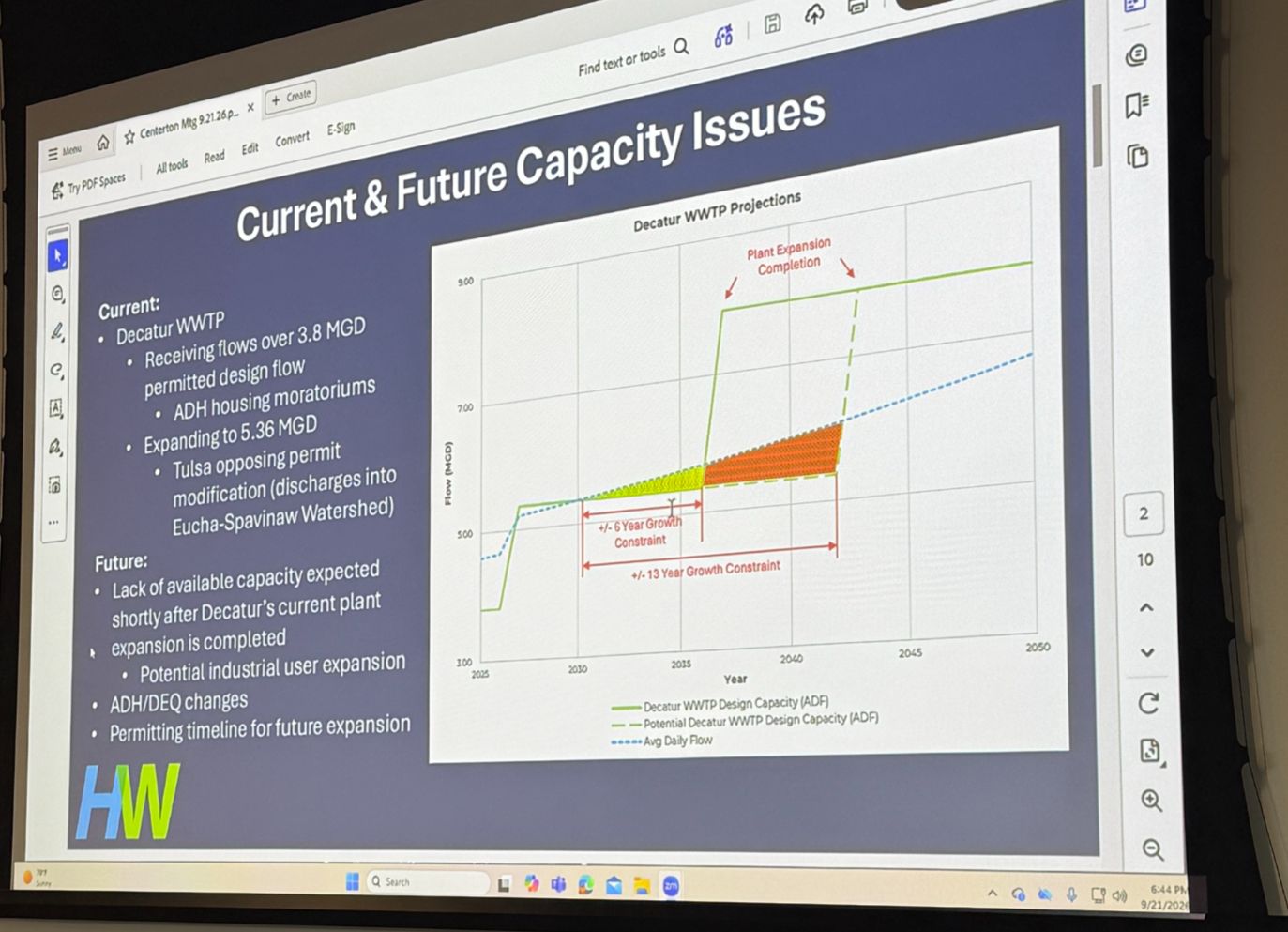
That is really the heart of this entire conversation. Centerton is trying to avoid getting out of the current sewer backlog only to find itself in essentially the same position again a few years from now.
The four options that were studied
The regional study narrowed Centerton’s wastewater choices into four main approaches.
One would keep the city primarily tied to Decatur through a future regional authority. Another would have Centerton build its own treatment plant. A third would eventually redirect essentially all of Centerton’s wastewater to NACA. The fourth would create a hybrid system, continuing to use Decatur while also building a smaller NACA connection that could provide additional capacity and a second outlet when needed.
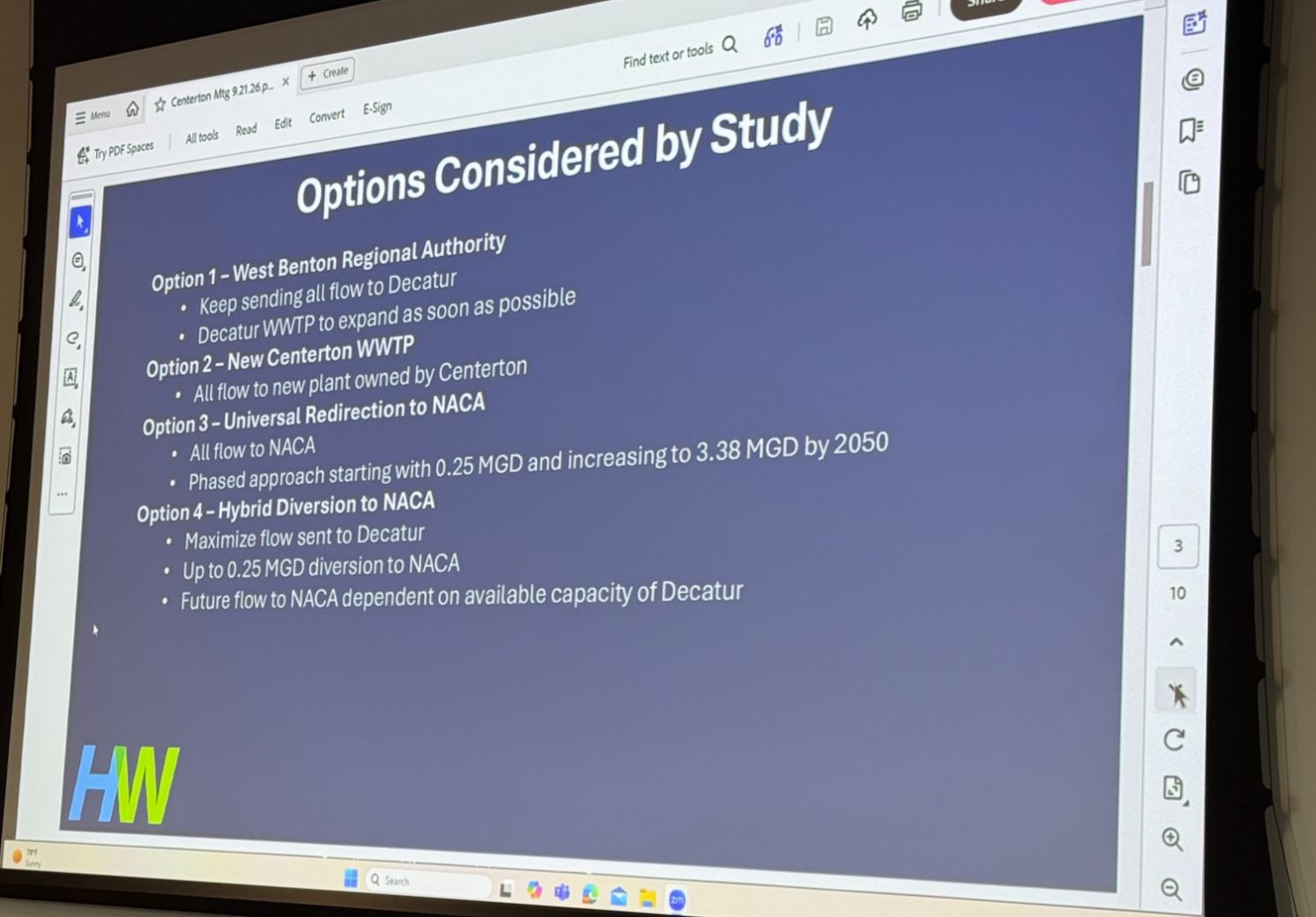
The meeting spent most of its time comparing those four choices, but by the end, the real conversation had narrowed considerably. Building Centerton’s own plant and moving everything to NACA were both identified as substantially more expensive and more difficult than the remaining two options. That left the Decatur regional approach and the hybrid NACA connection as the paths receiving the most serious attention.
Option 1: Stay with Decatur through a regional authority
The lowest-cost option in the study was what the presentation called the West Benton Regional Authority.
Under that concept, Centerton would continue sending most or all of its wastewater to the Decatur plant, but the treatment system would eventually be governed under some form of regional structure rather than remaining solely a City of Decatur operation.
The estimated present-worth cost was about $105 million. Benzing was careful to explain that this is not a $105 million construction bill. Present worth is simply a way of taking the expected costs over the study period and converting them into a common value so the options can be compared fairly.
Because Centerton already has the infrastructure needed to send wastewater to Decatur, this option does not require a large new collection-system investment on the Centerton side. It could also give Centerton direct representation in the governance of the treatment system, which would be a meaningful change from the current arrangement.
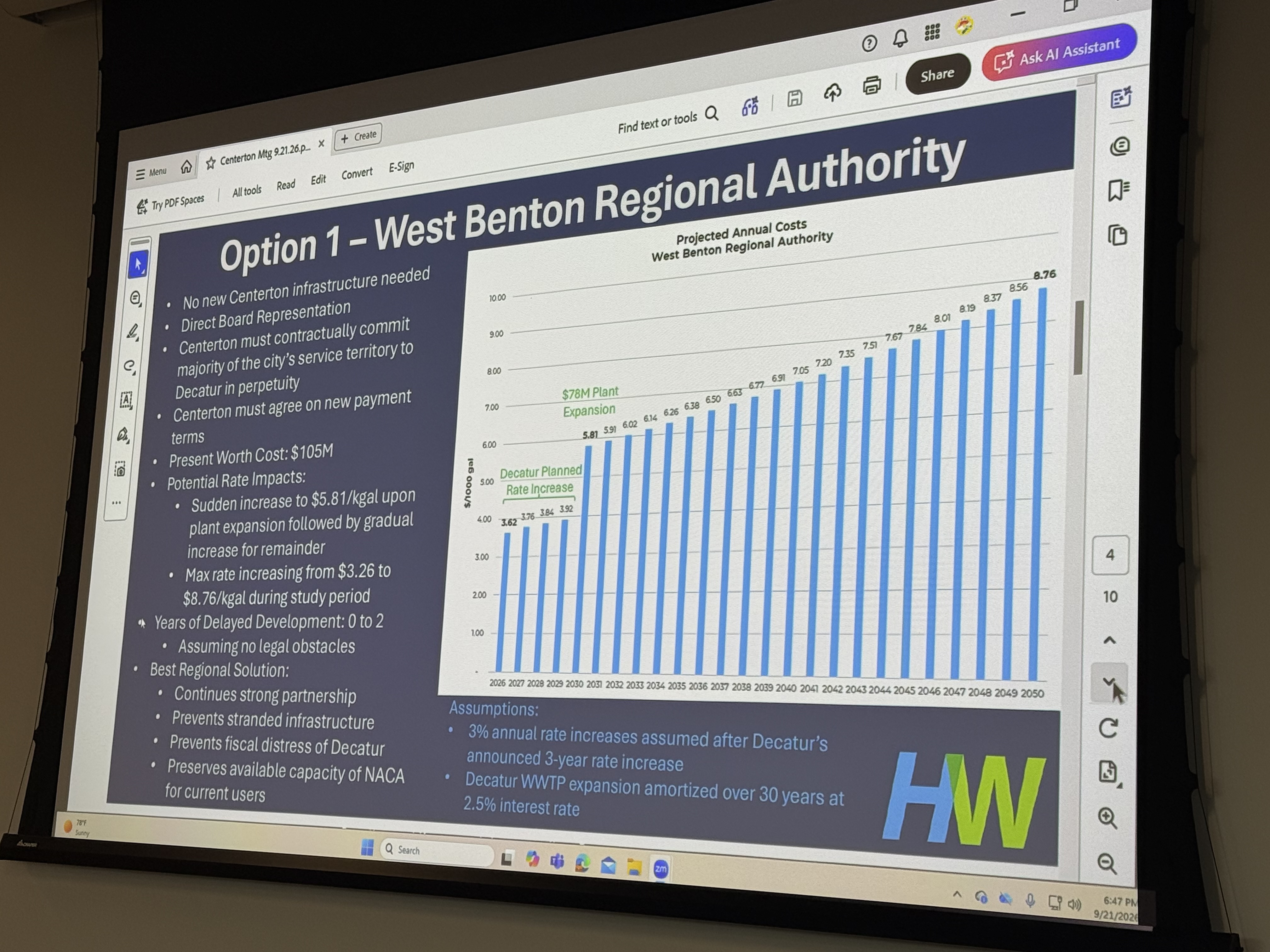
The challenge is that this option depends on several things Centerton does not fully control.
Decatur’s treatment plant discharges into the Eucha-Spavinaw watershed, which ultimately feeds Tulsa’s drinking-water supply. Tulsa has challenged the permit modification associated with Decatur’s current expansion, and the study team warned that future expansion could be delayed if additional permitting leads to more legal challenges.
There are also questions about how a regional authority would actually work. Board representation, voting power, payment terms, contracts, future expansion and the role of Decatur’s large industrial user would all have to be negotiated.
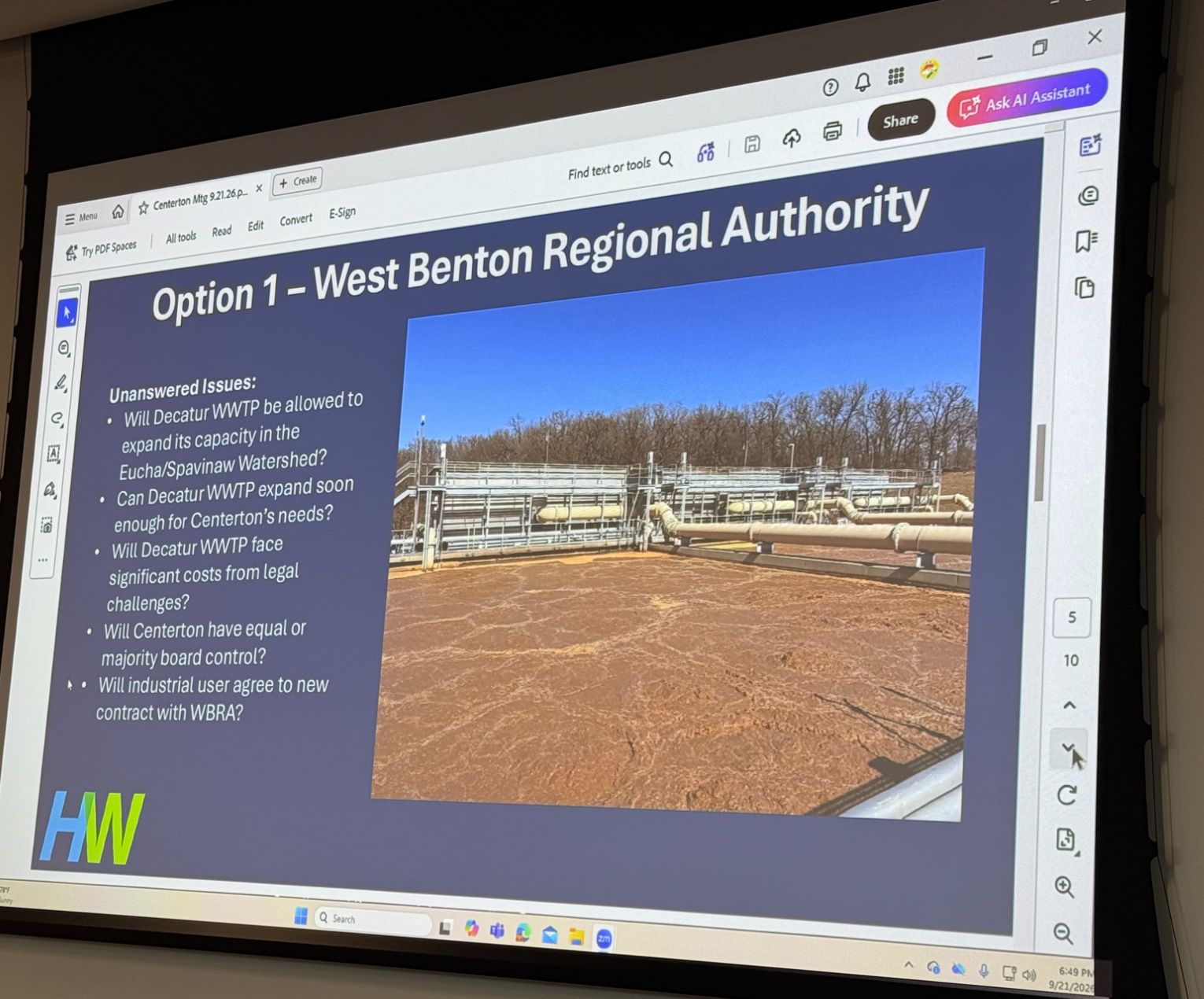
Hawkins-Weir said there appears to be a possible path toward an agreement with Tulsa, particularly around treatment standards and phosphorus loading, but those conversations have not yet produced a formal agreement. That uncertainty is a big part of why the NACA option remains so important.
Option 2: Build a Centerton wastewater treatment plant
The study was much less favorable toward Centerton constructing its own treatment facility.
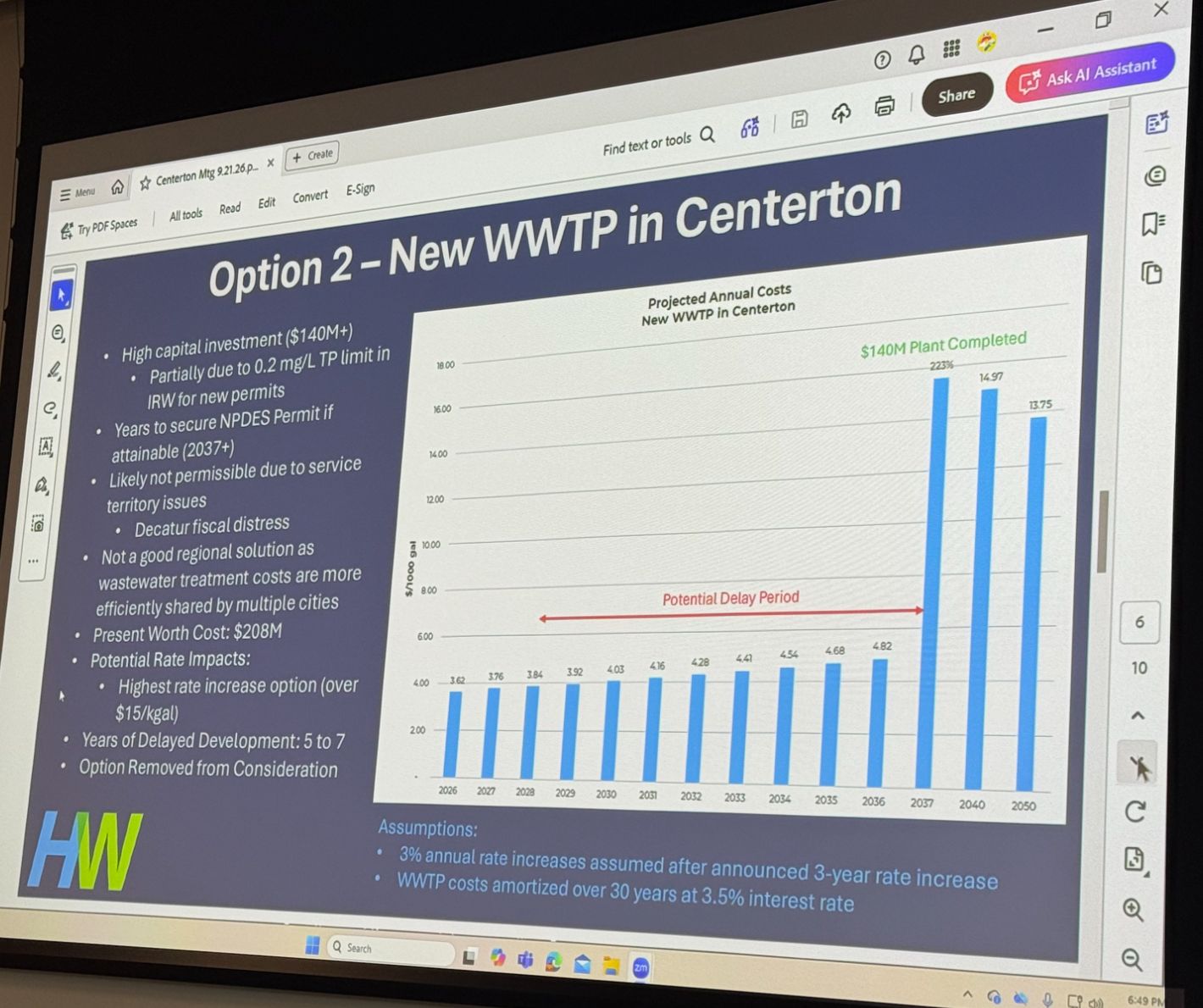
This was the most expensive option presented, with an estimated present-worth cost of roughly $208 million and a capital investment of more than $140 million for the plant itself. It would also require a lengthy permitting process, particularly if the discharge ultimately went into the Illinois River watershed, where phosphorus limits are extremely restrictive.
The timeline was another problem. The presentation estimated that a new Centerton-owned plant could take until 2037 or later to permit and complete, creating the potential for five to seven years of development delay along the way.
For those reasons, the study team removed this option from further consideration.
Option 3: Move everything to NACA
The third option would eventually redirect essentially all of Centerton’s wastewater to NACA.
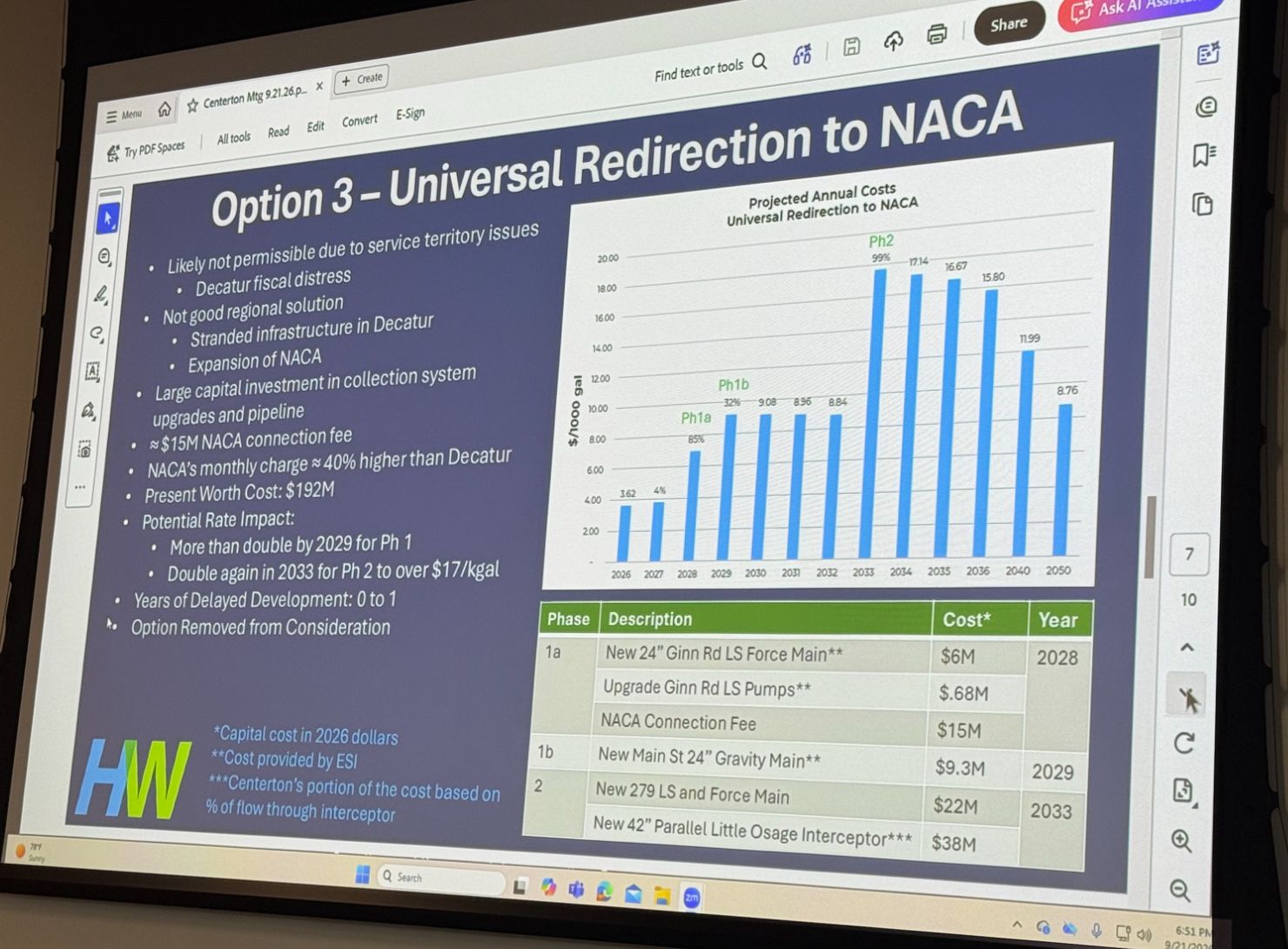
That approach could reduce some of the risk associated with relying on future Decatur expansion, but it comes with a much larger infrastructure price tag. The study estimated a present-worth cost of about $192 million.
Getting all of Centerton’s wastewater to NACA would require multiple phases of new infrastructure. The presentation included a major connection fee, new force mains, lift-station improvements and, eventually, participation in additional NACA interceptor capacity as the system grows.
The study also raised a broader regional concern. If Centerton moved completely away from Decatur, existing treatment infrastructure there could become underused while NACA would have to accelerate expansion for its existing users. There are also contractual and service-territory issues that would have to be resolved before Centerton could simply redirect all of its wastewater elsewhere.
Because of the cost and those regional complications, Hawkins-Weir did not recommend this as Centerton’s primary long-term solution.
Option 4: Keep Decatur, but add a NACA connection
The hybrid option is where the discussion became much more interesting.
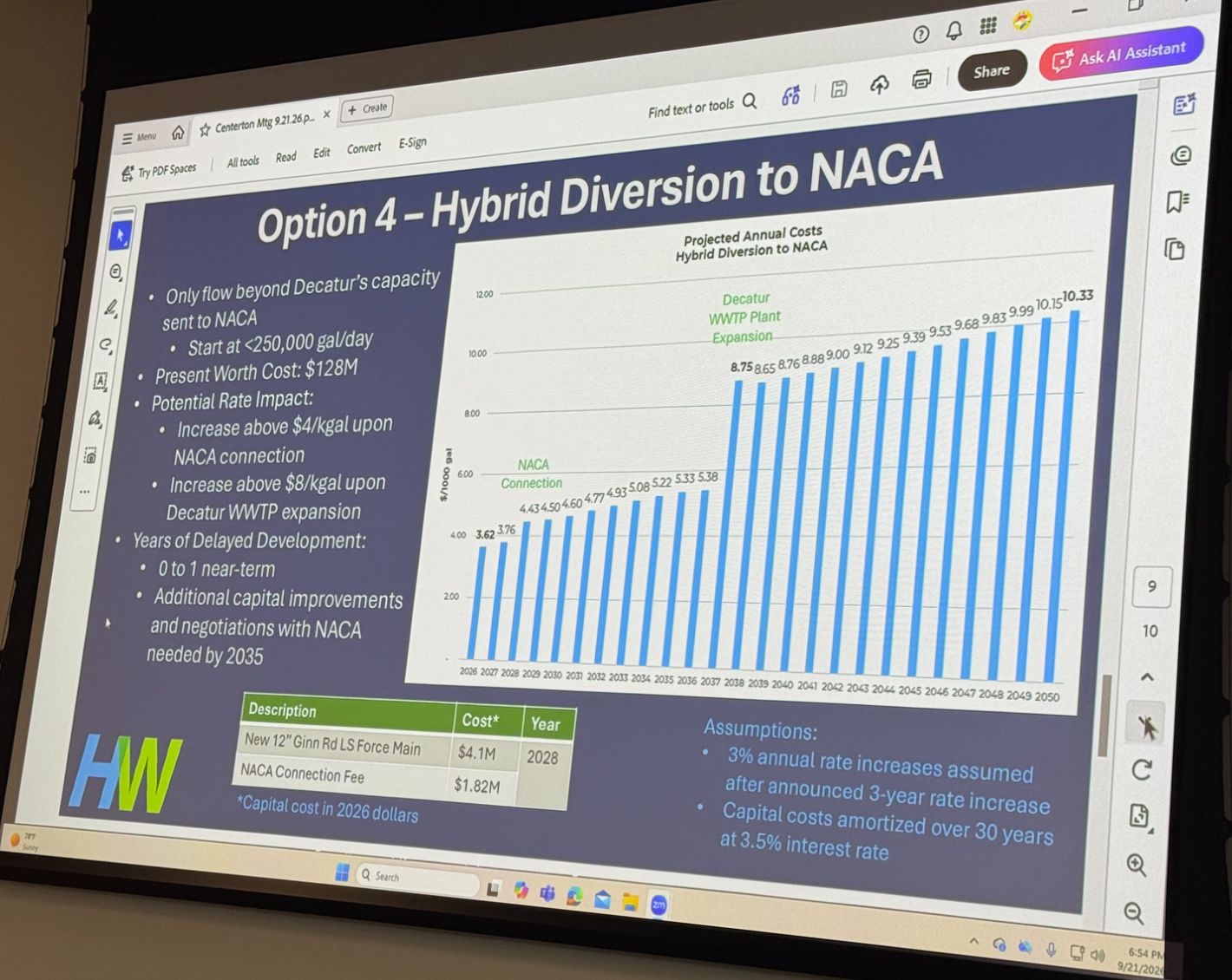
Rather than moving everything to NACA, Centerton would continue sending most wastewater to Decatur while building a connection from the Ginn Road lift station to NACA’s existing interceptor near Little Osage Creek.
The initial request would be for up to approximately 250,000 gallons per day of treatment capacity.
The presentation estimated about $4.1 million for the proposed force main and about $1.82 million for the initial NACA connection fee. The total present-worth cost for the hybrid approach was estimated at roughly $128 million.
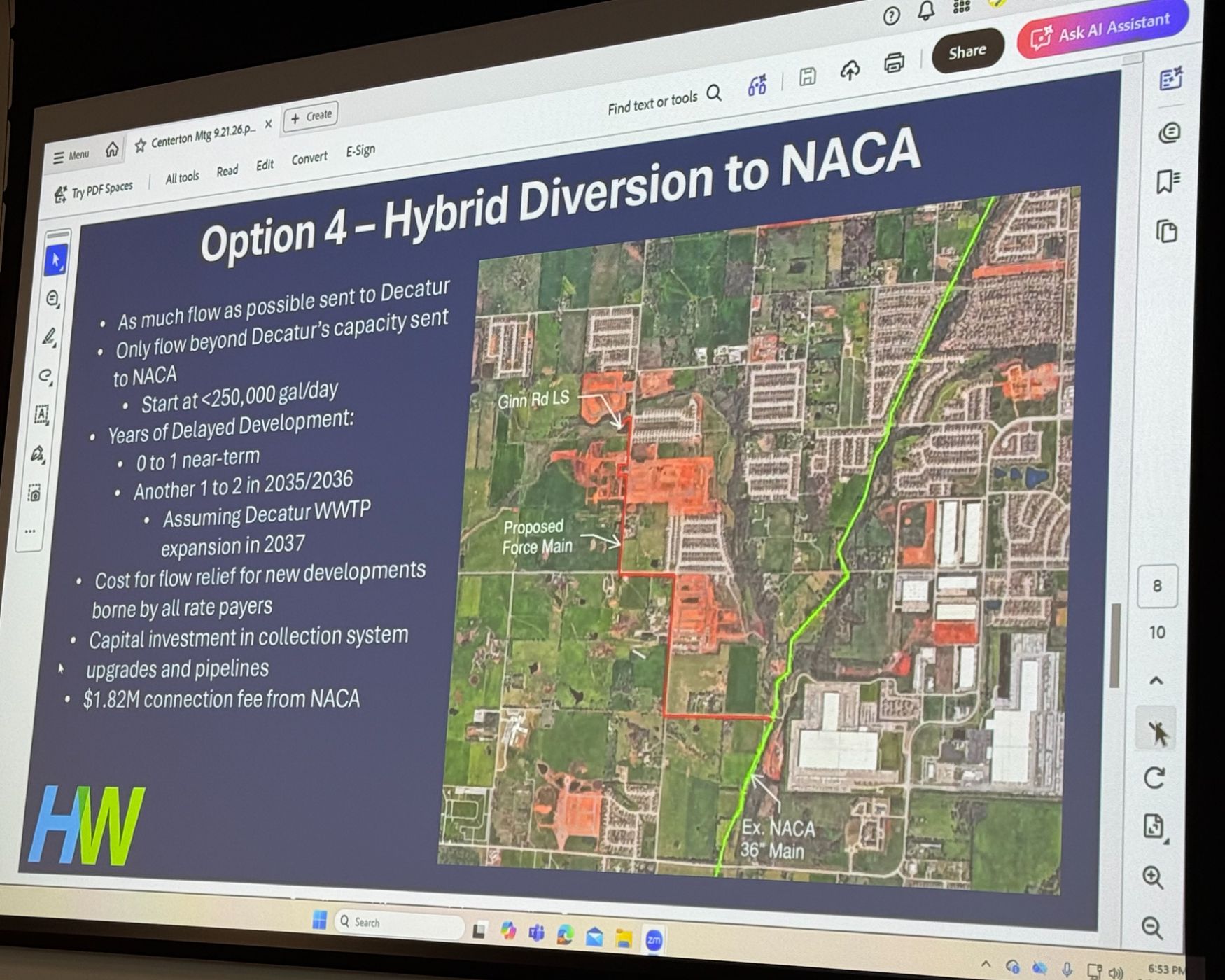
That initial quarter-million gallons per day is not intended to be Centerton’s forever solution. It is more of a pressure-release valve that gives the city another option while the larger Decatur question is being resolved.
If Decatur can expand successfully and on time, most wastewater could continue flowing there. If that expansion gets caught up in litigation, permitting or other delays, Centerton would at least have another outlet available instead of waiting until a new capacity crisis has already arrived.
The NACA connection fee is clearer than it was before
One of the most useful pieces of information from the meeting was clarification on NACA’s connection fee.
There have been much larger numbers discussed publicly in the past, and one commissioner specifically asked whether the approximately $1.8 million figure presented for the initial connection was real or simply an estimate.
Benzing explained that the state study updated an older NACA connection-fee model so the numbers could be calculated using current conditions. Using that updated methodology, the fee for approximately 0.25 million gallons per day came out to about $1.82 million.
If Centerton eventually wanted much more capacity, the fee would increase. The study showed roughly $15 million for about 2 million gallons per day. NACA would also have to determine whether it actually had that additional capacity available before Centerton could simply purchase it.
That makes the hybrid option much easier to understand. The initial connection is relatively modest compared with a full-system move to NACA, but expanding that relationship later would require more money, more infrastructure and additional negotiations.
The recommendation is to keep both doors open
The study team did not recommend immediately choosing one system and abandoning the other.
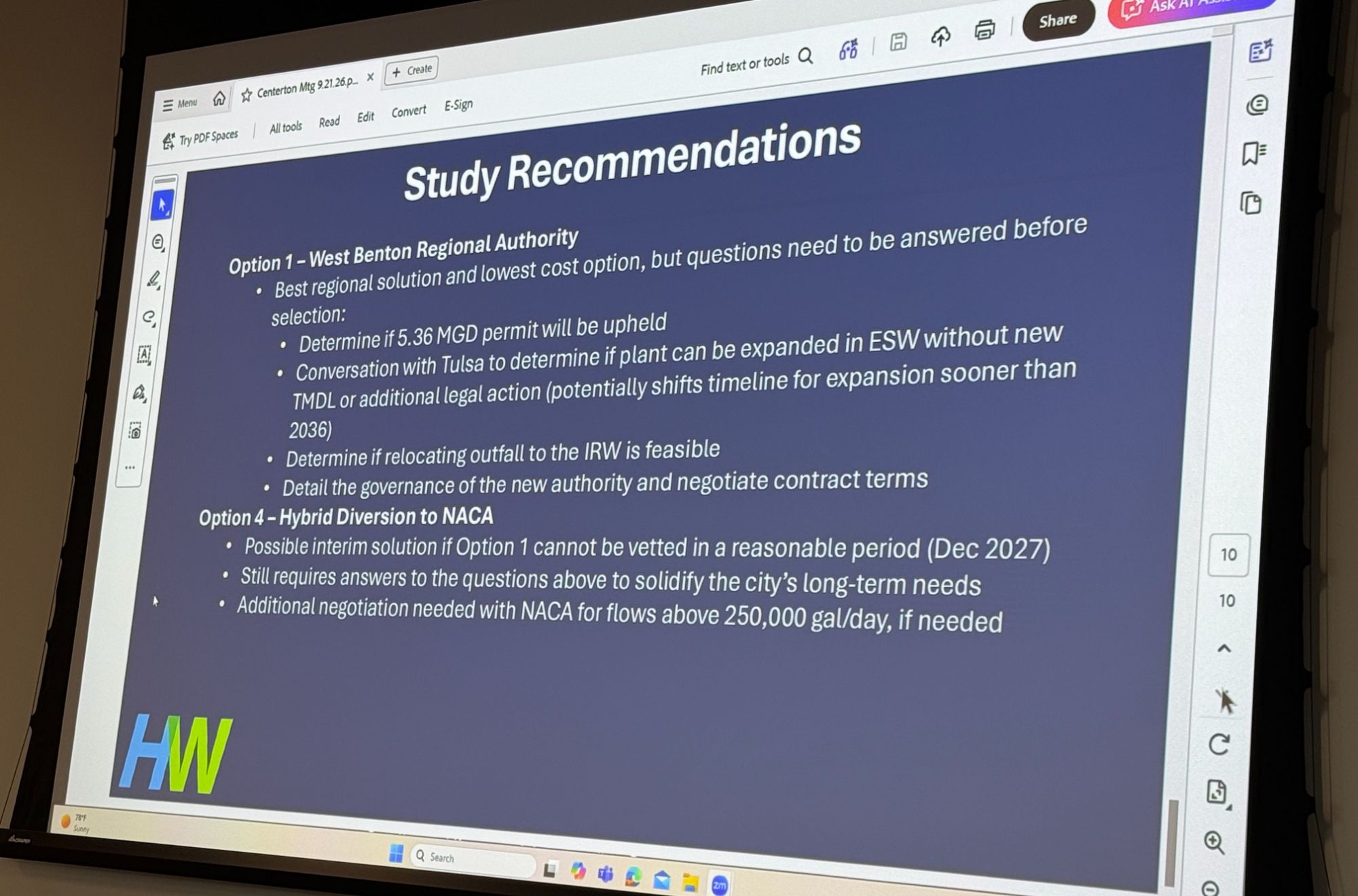
Hawkins-Weir’s recommendation was to continue designing the NACA pipeline while Centerton, Decatur and the other stakeholders work through the questions surrounding Tulsa, permitting and a possible regional authority.
The pipeline design is expected to continue into roughly summer 2027. Before the city reaches the point of actually bidding and building the project, the recommendation is to stop and evaluate where those other negotiations stand.
If Decatur has a clear path to expand and the legal uncertainty has been resolved, Centerton may decide the additional NACA infrastructure is not immediately necessary. If those conversations are still stalled, the city would already have a designed project ready to move toward construction rather than beginning from scratch.
Utility Commissioner T.J. Wells pushed for moving even faster on the NACA side. He said he did not believe Centerton should wait until the pipeline design is finished before beginning formal negotiations with NACA.
His concern was less about abandoning Decatur and more about redundancy. Centerton has relied on one wastewater-treatment outlet for more than a decade, and even under a future regional authority, some of the variables would still be outside the city’s control. Wells argued that establishing a second connection gives Centerton more flexibility if circumstances change again.
Benzing said he did not disagree with beginning those discussions sooner. His recommendation was more about delaying the actual construction commitment until officials have more information.
That may be the most important policy question coming out of this meeting. The least expensive path and the path with the most redundancy are not necessarily the same thing.
The current development backlog may finally start moving
There was also encouraging discussion for anyone who has been following the existing sewer restrictions.
Benzing explained that the permitting environment itself is changing. Historically, the Arkansas Department of Health relied heavily on standardized wastewater assumptions, including the commonly discussed figure of 100 gallons per person per day.
Under the newer approach being developed through the Arkansas Department of Environmental Quality, engineers are expected to have more ability to use actual system data and hydraulic modeling to demonstrate available capacity. Centerton’s real-world figures are closer to approximately 70 gallons per person per day, according to the discussion.
Centerton Utilities is also developing an updated hydraulic model that should give the city much better information about actual capacity within its collection system.
Combined with Decatur’s current expansion, officials expect those changes to give Centerton room to begin moving projects again.
The bigger concern is how quickly that new capacity gets used.
Is 250,000 gallons enough?
That question came up repeatedly during the second half of the meeting.
The Ginn Road lift station currently handles somewhere around 100,000 to 120,000 gallons per day. The proposed NACA connection would initially allow up to about 250,000 gallons per day, giving that part of the system room to grow while also freeing capacity elsewhere.
But several people questioned how long that would really last, particularly when Centerton already has thousands of housing units in different stages of development or waiting on sewer capacity.
One estimate discussed during the meeting suggested that 250,000 gallons per day could equate to roughly 1,275 homes using an assumption of 2.8 people per household and 70 gallons per person per day. Officials also acknowledged that this is only a rough way to illustrate capacity because Centerton’s future growth will not be made up entirely of single-family homes. Apartments, commercial uses and higher-density projects all have different demands.
The quarter-million-gallon number was repeatedly described as a starting point, not the maximum amount Centerton might ever send to NACA.
How big should the pipeline be?
That led to another practical question: if Centerton is going to spend millions of dollars building a connection to NACA, should the city install a larger pipe now so it has more room for future growth?
There was understandable concern about spending money on infrastructure only to discover a few years later that it was too small.
Utility officials explained that sewer infrastructure is not quite that simple. Oversizing a force main can create operational problems if there is not enough wastewater moving through the line to properly maintain it. So the goal is not necessarily to install the biggest pipe Centerton can afford today.
The design needs to balance current flows, expected growth, maintenance requirements and the ability to expand later. ESI is still working through those questions as the project design moves forward.
Who pays for the additional capacity?
The roughly $6 million hybrid connection also led into a conversation about capacity fees.
If Centerton builds additional sewer infrastructure, one option is to spread those costs across all utility customers through their rates. Another is to assign more of the cost to new development that needs the additional capacity.
Benzing described that basic philosophy as growth paying for growth.
Centerton already uses capacity fees, and officials said an updated study is underway. The utility had been waiting for this regional wastewater analysis so the new projects and expected future costs could be incorporated into the calculation.
A very preliminary number of roughly $8,000 to $10,000 per development or connection was mentioned as an example during the discussion, but officials immediately cautioned that the actual Centerton study is still underway. No new capacity fee was adopted during this meeting.
The real issue still to be decided is how much of future sewer expansion should be paid by the people already on the system and how much should be paid by new growth creating additional demand.
The regional authority is still a concept, not a finished organization
Another thing worth clarifying is the phrase “West Benton Regional Authority.”
That does not mean a fully formed organization already exists with that exact structure.
Chelsea Boozer, who worked on the governance side of the state wastewater study, explained that there are still decisions to make about who would participate, how many board seats each entity would receive, how votes would be structured, how costs would be divided and how future capacity would be allocated.
Benzing also noted that “West Benton Regional Authority” is essentially the working name used in the study. The final arrangement could take a different form and could potentially involve a broader regional structure.
The discussion suggested that creating such an entity could take roughly a year or more, although some preliminary work has already been done.
So when this comes up in future meetings, it is probably best to think of it as a regional structure still being negotiated rather than a completed authority that Centerton has already agreed to join.
There is still another fallback option
One additional possibility came up during questions that was not given the same attention as the four primary options.
If Decatur ultimately cannot secure a workable path for future expansion in the Eucha-Spavinaw watershed, another possibility could involve moving Decatur’s treated effluent toward the Illinois River watershed.
That would require additional environmental studies and stricter phosphorus requirements, so Hawkins-Weir did not describe it as the preferred route. But it remains another possible path if the Tulsa issues cannot be resolved.
What happens next
Because this was a work session, nobody voted to choose Option 1 or Option 4.
Wells said the Utility Commission could consider formally approaching NACA at an upcoming meeting to begin negotiating the initial capacity request. He also suggested that Centerton Utilities consider retaining Hawkins-Weir after the state-funded portion of the regional study ends so the firm can continue working through the remaining negotiations and technical questions.
There was also discussion about bringing in outside legal counsel with specific experience in regional utility agreements to assist with the process.
Those were suggestions and possible next steps, not actions approved during the September 21 meeting.
The full regional study is also still moving through the state process. Hawkins-Weir said the draft was being presented to the study’s steering committee immediately after this meeting, with a broader public release expected afterward.
My Takeaway
For me, the hybrid option makes the most sense because I do not want Centerton to solve today’s sewer problem in a way that leaves us vulnerable to the exact same kind of capacity issue again a few years from now.
I think continuing the relationship with Decatur still matters. We already have significant infrastructure in place, the partnership has served Centerton for years, and the regional approach may ultimately be the most cost-effective long-term solution. But I am not comfortable with Centerton continuing to rely on only one treatment path when so much of that path depends on permitting, litigation, another entity’s capacity and decisions that are not entirely within our control.
That is why I support continuing the Decatur regional work while also moving forward with the NACA connection.
To me, that is not abandoning Decatur. It is giving Centerton another option.
We have already seen what happens when growth catches up to infrastructure and there is nowhere else for that wastewater to go. Projects get delayed, development gets caught in limbo, and the city ends up trying to solve a long-term problem under immediate pressure. I do not want us back in that position because we chose the least expensive option today without accounting for the risk that comes with relying on a single outlet.
That does not mean we should build more infrastructure than the engineering supports or spend money simply because we can. The questions around pipe sizing, how much capacity we initially purchase from NACA, how quickly that capacity may need to increase and how the cost is divided between existing ratepayers and future growth all still deserve careful work.
But I would rather see Centerton build flexibility into the system now than find ourselves wishing we had another option when the next constraint arrives.
The hybrid approach gives us a chance to keep a strong relationship with Decatur, continue pursuing the regional solution, and still establish a second connection that Centerton can grow into over time. After everything this city has experienced with sewer capacity over the last couple of years, I think having more than one path forward is worth pursuing.
Categories
Recent Posts