Centerton City Council Recap: Flock Cameras Terminated, Water & $16.59M Bond
Centerton City Council Recap | August 11, 2026
The August 11 Centerton City Council meeting was a long one, but there was a lot packed into it. The agenda included four ordinances, water and sewer financing, new water conservation procedures, employee policies, three Planning Commission appointments and an update on the city's ALPR and public safety camera system.
The issue that brought the largest crowd and the most public comment was Flock Safety. After an extended discussion about the contract, privacy concerns, how the technology was functioning and what the city actually needs from a public safety camera system, Council ultimately voted unanimously to terminate the Flock system.
There was also quite a bit of discussion about something that has been at the center of many conversations lately: water. That included both the city's current water conservation situation and the financing of major water and sewer infrastructure improvements.
Flock Contract Will Be Terminated
This was easily the biggest discussion of the night.
Police Chief Cody Harper walked Council through the city's experience with Flock so far, and he was pretty candid that implementation had not gone as planned. Of the 19 cameras originally planned, 16 had been installed at the time of the meeting, with the system roughly split between license plate readers and more traditional camera units. Chief Harper explained that the original purpose was broader than license plate readers and included cameras around parks and other areas where the city has dealt with vandalism or wanted additional visibility.
Council spent a significant amount of time reviewing questions about the contract itself, including who owns or can access data, how long information can be retained and what control the city really has once information enters the Flock system. There was also a larger policy conversation about whether the public safety benefit justified the privacy concerns residents had raised.
That distinction matters because there were really two conversations happening at once. One was whether Centerton needs cameras or technology to help protect parks, public property and residents. The other was whether Flock is the right system to do that.
Several Council members made clear that terminating Flock did not mean abandoning the need for security. Public Works also described repeated vandalism at city parks and the staff time being spent repairing damage, so there is still a problem to solve. The question now becomes what a better solution looks like.
Council reopened public comment specifically for the Flock discussion, and resident feedback was overwhelmingly opposed to continuing the system. Concerns centered on privacy, data retention, access to information, potential misuse and the broader implications of creating a searchable network of vehicle movements. There was also support for finding a different way to monitor parks that does not create the same concerns.
I spoke during that discussion as well. My questions centered on what happens to the funds allocated for Flock if the contract is terminated, how long data is retained, who can access it and what guardrails are actually in place. City Attorney Brian Rabal said his understanding was that the city had not yet paid Flock, although he also cautioned that the company could dispute a termination. Chief Harper estimated the total Flock allocation at roughly $61,000 to $62,000.
After public comment closed, Justin Cowgur made the motion to cancel and terminate the system and suggested that the city continue working on the larger security question. Wendy Henson seconded, specifically referencing the amount of resident feedback Council had received and the need to find other ways to protect residents and city parks.
The roll-call vote was unanimous. Cliff Thompson, Justin Cowgur, Wendy Henson, Josie Reed, Joshua Hagan and Cody Miles all voted yes.
Bottom line: Centerton is moving forward with terminating Flock, but the conversation about how to provide security at parks and other public spaces is not over.
$16.59 Million Water and Sewer Bond Financing Finalized
Council also finalized Ordinance 2026-28, authorizing $16.59 million in Water and Sewer Revenue Improvement Bonds, Series 2026.
This followed last month's ordinance that established the parameters under which the bonds could be sold. Bond representatives explained that the bonds had since been priced and the mayor had entered into the purchase agreement within those previously approved limits.
A major question during the meeting was why this ordinance needed to be passed immediately rather than being allowed to go through readings at multiple meetings.
Bond representatives and bond counsel explained that this was a ratifying ordinance following the actual pricing of the bonds. Delaying approval after investors had placed orders would mean canceling that transaction, going back to market and accepting the risk of different interest rates and potentially reduced investor confidence.
The previously authorized maximum interest rate was 5.25 percent, while the financing came in at 4.751 percent according to the presentation. The final bond amount also came in below the maximum parameters previously authorized by Council. Bond representatives said more than $40 million in orders were received for approximately $16.59 million in available bonds and expected the transaction to settle in mid-September.
Council unanimously voted to suspend the requirement that this ordinance be read at three separate meetings, then adopted Ordinance 2026-28. The emergency clause was also approved.
There was a broader conversation around the cost of borrowing as well. Residents have raised concerns about the amount of interest that will be paid over the approximately 30-year life of the debt. Water and Sewer representatives acknowledged that the total interest is significant, while explaining that the alternative would generally mean raising substantially more cash upfront through higher rates or another revenue source.
One interesting piece of that discussion was the possibility of using sales tax revenue toward water and sewer infrastructure in the future. It was discussed as something other cities do, but Council did not take any action on that idea Tuesday night.
Why Centerton Is Back Under Water Conservation Measures
Water was actually a major topic before Council ever reached Ordinance 2026-30.
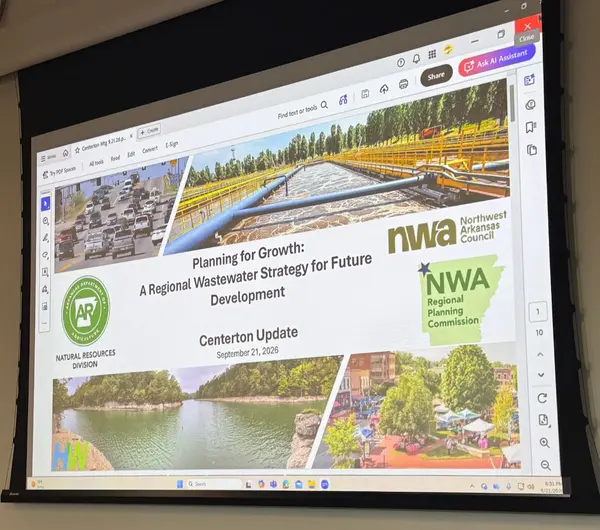
During public comment and the department discussion, Water and Sewer representatives explained that the current concern is not simply how much water is sitting in Beaver Lake. The immediate issue is the ability of Benton Washington Regional Water Authority to pump and distribute enough water to all of the communities it serves during periods of extremely high demand.
Officials explained that the regional system was still recovering from the large water-main break last month when high overnight demand caused storage levels to fall again. Centerton Utilities said the regional provider had once again asked communities to reduce irrigation, and the current request involved even and odd watering days.
That distinction is important. The concern described Tuesday night was delivery capacity and storage levels during peak usage, not that Beaver Lake itself had suddenly run out of water.
Ordinance 2026-30 Creates Enforcement for Water Conservation Emergencies
Council then considered Ordinance 2026-30, which creates a formal process for declaring water conservation emergencies, implementing mandatory conservation measures and enforcing those measures through penalties.
There was a lot more discussion here than simply "don't water your grass."
Council asked how residents would be notified, how violations would be handled, whether there was an appeal process, who would enforce the ordinance and what would happen when someone was out of town or simply did not receive the notice.
Utility staff said they intend to use multiple communication methods, including text messages, email, the utility billing system, the city's website and the My Centerton app. Council also pushed for a paper explanation to go out with utility bills so residents who are not on social media or comfortable with technology are not left out.
There was discussion about allowing an educational or grace period before penalties begin, but Council did not formally establish a specific 30-day or 60-day grace period during the vote Tuesday night. That was discussion, not a condition attached to the ordinance.
The procedural vote was also worth noting. Suspending the normal three-meeting reading requirement required four votes. Justin Cowgur and Wendy Henson both wanted additional readings, while the remaining four votes allowed Council to move forward that evening. Henson explained that her concern was giving residents enough time to understand that violations could now result in fees.
The ordinance ultimately passed.
Utility Director Malcolm Keith then gave a much more concrete explanation for the emergency clause. He said the city's water tower had been steadily draining for two to three days and system pressure had reached the point that pumps were close to having to be shut off. He also said the new water tower, originally expected to be completed earlier this year, remained delayed, with substantial completion then anticipated around mid-September and the city preparing to pursue liquidated damages related to the delay.
The emergency clause passed as well, with Henson voting no.
Municipal Facility Fee Ordinance Tabled Again
Ordinance 2026-22, dealing with municipal facility fees and certain fee waivers, came back after being tabled previously.
Rather than rushing it through, Council went back through several of the questions raised at the prior meeting. Among them were who qualifies for complimentary community-room use, whether terms such as "civic" and "cultural" were defined clearly enough, how field reservations are handled, whether groups can effectively monopolize athletic fields and how deposits work for organizations that use city facilities regularly.
Council also caught wording that needed to be corrected in the athletic-field fee schedule.
Ultimately, Cliff Thompson moved to table the ordinance again so the language could be cleaned up before adoption. The motion carried.
I think this is an important distinction anytime I write these recaps: Ordinance 2026-22 was not approved Tuesday night. It will come back after revisions.
Annexation Receives First Reading Only
Ordinance 2026-29 involves the annexation of nine properties on the south side of Centerton in the Shady Acres Road area.
Because annexation ordinances must go through readings on three separate occasions, Council did not suspend the rule for this one. Tuesday night was only the first reading.
Council unanimously approved moving the ordinance through its first reading. It has not received final approval yet and will have to return for the remaining readings.
Vacation Buyback Policy Revised
Council returned to the city's employee vacation-buyback policy, which had also been discussed previously.
HR Director Jocelyn Murphy explained that she had gone back through feedback from other municipal HR departments around Arkansas and corrected an earlier impression that similar buyback programs were common among the cities that responded.
Most of Council's discussion centered on how to preserve the benefit without creating an unpredictable financial liability for the city.
The final direction keeps the existing maximum buyback at 100 hours, removes the proposed additional emergency buyback and adds a requirement that an employee must have used at least 40 hours of vacation during the preceding 12 months to qualify. The idea is to continue offering the benefit while also encouraging employees to actually take time off.
Council also discussed whether vacation buyback should eventually be accounted for more deliberately during the annual budgeting process rather than handled entirely as it occurs. That was a discussion point for the future, not a separate budget action Tuesday night.
Retirement Rehire Policy Approved
Council separately discussed adding clearer language for employees who retire and later seek reemployment with the city.
Much of the discussion involved retirement-system rules, waiting periods and circumstances in which retirees may or may not be eligible to return. Council ultimately approved the retirement reemployment policy as presented.
Water and Sewer Audit Acknowledged
Council formally acknowledged receipt of the Water and Sewer audit report.
Mayor Edwards said during the meeting that he was not aware of any findings in the audit. Because the audit itself was not one of the documents provided with this recap, I'm leaving that exactly where it belongs: as the mayor's statement during the meeting, rather than independently characterizing the audit. Council's motion to acknowledge receipt passed without opposition.
Three Planning Commission Appointments Approved
Council appointed three members to the Centerton Planning Commission for terms ending June 30, 2029: Joey Ingle, Kylee Sawyer and Michael Mullenax. The agenda itself lists the three appointments and the term ending June 30, 2029.
Mayor Edwards said the city received 13 applications, one applicant withdrew and the remaining 12 were interviewed before the three recommendations were made.
Sawyer discussed her experience working on both municipal and private development projects in Centerton. Council specifically asked about circumstances in which her professional work could require her to recuse from a Planning Commission vote, and she acknowledged there could occasionally be projects where that would be appropriate.
Mullenax discussed his previous law-enforcement career and experience serving on a development review committee, including Crime Prevention Through Environmental Design principles and reviewing developments from a public-safety perspective.
Ingle is a current Planning Commission member and was reappointed. A statement read on his behalf highlighted approximately 20 years of experience involving planning, engineering, land development, design and public utility infrastructure.
Council approved all three appointments together without opposition.
Updated Police Policy Manual
Council also formally acknowledged receipt of the updated Police Policy Manual. The mayor noted that the ALPR policy, including corrections, had been included with the training resources provided to Council. The acknowledgement passed without opposition.
Public Comment Raised a Bigger Communication Question
One of the quieter but important conversations of the night came from resident Hannah Pierce, who raised concerns about how heavily the city relies on Facebook to communicate.
Her point was simple: even if information is posted, that doesn't necessarily mean residents are seeing it. She specifically raised the needs of older residents and people who do not regularly use social media.
That led to a productive discussion about using utility bills, text messages, QR codes, the My Centerton app and other communication tools to reach people in more than one place. Utility staff indicated several of those options were workable.
With the water situation we're dealing with right now, that conversation could not have been more timely.
Update on the Proposed 88-Acre Land Donation
Council also circled back to a public-comment question about the approximately 88 acres being discussed for donation to the city.
Staff said the property is owned by Oak Landing Partners LLC and that the transfer is still in process, with attorneys working through final language. The donor's requirements center on keeping the property as open space, green space or park use.
City Attorney Brian Rabal said his concern is making sure the city is adequately protected if it invests public money into the property. Some of the draft language would apply in perpetuity and potentially allow enforcement of the use restrictions far into the future, so he is seeking clearer protections or an appeal process before the transfer is finalized.
No final land transfer occurred Tuesday night. The agreement is still being worked through.
A Few Other Notes
The July 14 City Council minutes were approved after two corrections to public-speaker names. Council also acknowledged the June 16 Water and Sewer Commission minutes and July 7 and July 21 Planning Commission minutes. July financial and court reports were accepted as well. During the financial report, Mayor Edwards noted that building-permit revenue was down and connected much of that decline to the ongoing sewer situation.
Coffee with the Mayor is scheduled for Saturday, August 15 at 9 a.m. at the Community Building, 290 North Main Street. A joint work session with the City Council, Planning Commission and public on the downtown plan is scheduled for August 24 at 6 p.m.
My Takeaway
There were several major policy decisions Tuesday night, but what stood out to me wasn’t just the votes it was how often Council had to slow down and actually work through the details in real time.
With Flock, this didn’t change because of a slogan or a talking point. It changed because residents showed up with specific concerns, Council members asked harder questions about the contract itself, and the Chief was honest about where the system wasn’t meeting expectations. That combination is what ultimately led to a unanimous decision to walk away from it.
With water conservation, the issue isn’t whether Centerton should take the system seriously it’s that residents deserve clarity before enforcement ever starts. If we’re asking people to change behavior or risk penalties, then the communication has to be just as strong as the policy itself. That part still feels like it’s catching up.
And with the facility-fee ordinance, Council did what good governing actually looks like when it’s working right: they stopped and said the language isn’t ready yet. Not because the idea was wrong, but because the details still didn’t match the intent.
That’s the part I keep coming back to. The real work in these meetings isn’t the final vote it’s everything that happens before it. The questions that get asked, the gaps that get exposed, and the moments where Council has to decide whether something is actually ready or just placed on an agenda.
And honestly, that only happens when people are paying attention. Residents came in, emailed, spoke up, and pushed for answers. Whether they agreed on the outcome or not, that pressure shaped the conversation in a real way Tuesday night.
Categories
Recent Posts